How to Choose the Right App Store Optimization Services for Your App
Three paths lead to better app store rankings: hire an agency, subscribe to a tool, or do it yourself. Each has a cost curve, a learning curve, and a ceiling. The right choice depends on four variables — your app's revenue, your available hours, your keyword landscape, and whether ASO is a one-time project or an ongoing capability you need to own.
This article is a decision framework, not a pricing guide. For specific dollar amounts at each tier, see the companion piece on ASO cost across tools, agencies, and DIY. Here, the question is different: given your situation right now, which path delivers the best return per dollar and per hour?
The Three Paths, Defined
App store optimization services fall into three categories. Each trades money for time differently.
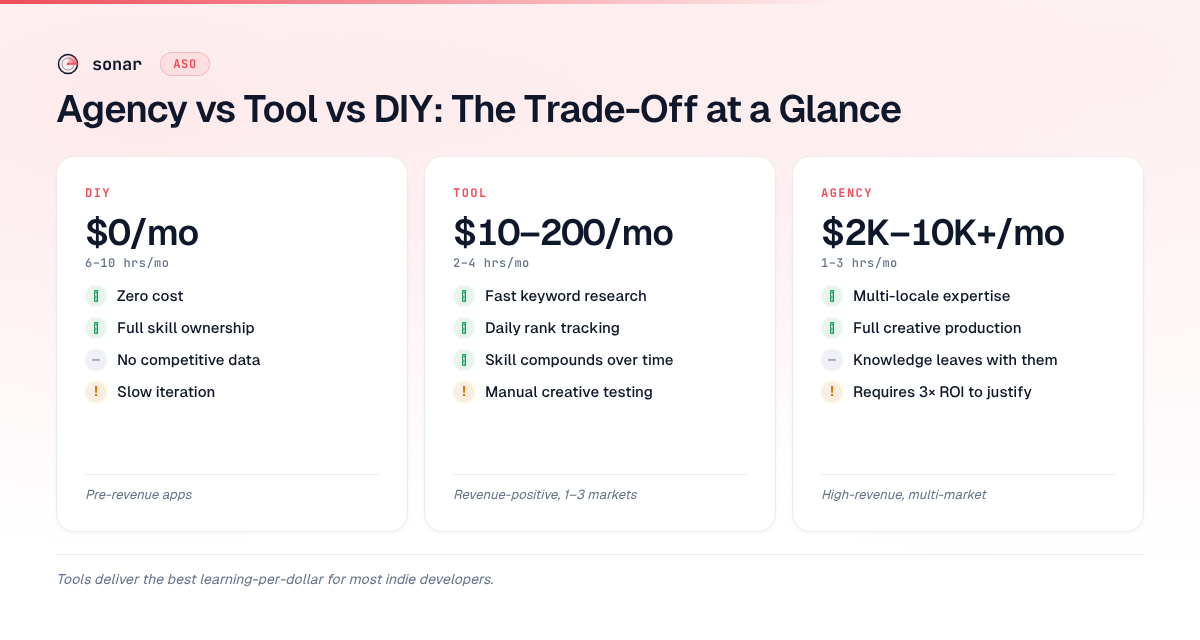
| Path | Typical monthly cost | Your time per month | What you learn |
|---|---|---|---|
| DIY (manual + free tools) | $0 | 6-10 hours | Everything — you build the skill |
| Tool-assisted (self-serve platform) | $10-200 | 2-4 hours | Most of it — the tool accelerates research, you still decide |
| Agency (full-service or boutique) | $2,000-10,000+ | 1-3 hours (reviews, approvals) | Little — you outsource the skill |
The cost column is obvious. The learning column matters more than most founders realize. When I built Sonar, the pattern I saw across hundreds of app developers was consistent: those who understood their own keyword data made better product decisions, not just better metadata.
When DIY ASO Makes Sense
DIY is the right starting point for any developer who has fewer than three live apps and whose combined app revenue is under $2,000/month. The economics are simple: at low revenue, an agency retainer exceeds the total revenue the app generates, and even mid-range tools have diminishing returns when you only have a handful of keywords to track.
What DIY actually looks like in practice:
- App Store Connect and Google Play Console give you your own search term data, impression counts, and conversion rates for free. Apple's App Analytics documentation confirms these metrics are available to all developers at no cost.
- Store autocomplete surfaces real user queries. Type your core keyword into the store search bar and record every suggestion — these are validated by actual search volume.
- Competitor listing analysis — reading the titles, subtitles, and descriptions of the top 10 apps for your target keywords — costs nothing but time.
- Free keyword tools provide baseline difficulty and popularity data. Our guide to free ASO tools for indie developers covers what is available at $0.
The ceiling of pure DIY is data quality. You can guess which keywords are competitive, but without difficulty scores derived from actual ranking data, you are optimizing blind. For a keyword like "budget planner," Sonar's keyword index shows iOS difficulty 65 with 185 competing apps versus Android difficulty 68 with only 30 results — the kind of cross-platform gap an agency or tool reveals but manual research misses (source: Sonar /api/v1/keywords/search, queried 2026-06-15).
That gap matters. A developer targeting "budget planner" on iOS faces 6x more competing apps than on Android, but the difficulty scores are nearly identical. Without data, you might assume the smaller result count means easier ranking. The scores tell you otherwise.
When a Tool Is the Better Investment
A tool becomes the better choice the moment your keyword list exceeds what you can track manually — typically around 10-20 keywords — or when you need to monitor rankings over time rather than checking once at launch.
The core value of tool-assisted ASO is not the data itself. It is the speed of iteration. An ASO keyword research tool lets you test a hypothesis — "will 'tip calculator' rank easier on Android?" — in seconds instead of hours. Sonar's keyword index puts "tip calculator" at iOS difficulty 40 and popularity 37, a mid-competition keyword where tool-assisted research makes the difference between ranking and guessing (source: Sonar /api/v1/keywords/search, queried 2026-06-15). On Android, "tip calculator" drops to difficulty 16 with popularity 44, showing how platform-specific ASO data prevents wasted effort on the wrong store (source: Sonar /api/v1/keywords/search, queried 2026-06-15).
What to look for in an ASO tool
Not all tools deliver equal value. The features that actually move rankings, based on what I have seen across apps using Sonar:
- Keyword difficulty scoring — calibrated against real ranking data, not estimated from download counts. See how keyword difficulty works for the methodology behind these scores.
- Daily rank tracking — weekly snapshots miss the algorithm fluctuations that tell you whether a metadata change worked. Our rank tracker guide explains what frequency matters and why.
- Cross-platform data — iOS and Android keyword landscapes differ substantially. A keyword that is easy on one store may be saturated on the other, as the "tip calculator" example above shows.
- Competitor keyword analysis — knowing which keywords your competitors rank for reveals gaps you can exploit.
The tool decision matrix
| Your situation | Recommended tool tier | Why |
|---|---|---|
| 1-2 apps, under $500/mo revenue | Free tools or budget ($10-20/mo) | ROI turns positive with even one ranking improvement |
| 3-10 apps, $500-5,000/mo revenue | Mid-range ($20-200/mo) | Portfolio tracking and cross-app keyword strategy pay for themselves |
| 10+ apps or $5,000+/mo revenue | Mid-range to enterprise ($200-500/mo) | Team features, API access, and deeper competitive data justify the cost |
| Developer/engineer workflow | API-first tool with CLI | Scripting and automation eliminate manual dashboard time — see ASO API workflows |
For most indie developers, a tool in the $10-50/month range covers 90% of what they will act on. Sonar's pricing starts at $19/month for unlimited keyword research, daily rank tracking, and competitor analysis — or prepaid API credits from $10 for developers who prefer scripting over dashboards.
When an Agency Earns Its Retainer
Agencies are not inherently overpriced. They are mismatched when the app's revenue does not justify the retainer, and they are well-matched when three conditions converge.
Condition 1: Revenue covers the retainer with margin. A 2023 survey by Clutch found that 52% of small businesses spending on digital marketing agencies allocate $1,000-$5,000/month, and the median reported ROI expectation is 3-5x within 12 months (source: Clutch, Small Business Marketing Survey 2023). For ASO specifically, the math works when your app earns at least 3x the agency's monthly fee. A $3,000/month retainer needs $9,000+ in monthly app revenue to be a rational bet.
Condition 2: Multi-market localization. Localizing metadata into 10+ languages with keyword research per locale is where agencies deliver the most value a tool cannot replicate. Apple supports 35 localizations for App Store metadata (source: Apple Developer Documentation, App Store localizations). Google Play supports localization in over 75 languages (source: Google Play Console Help). Researching keywords in each language requires native speakers or near-native fluency — a capability most developers and tools lack.
Condition 3: You need creative optimization at scale. A/B testing screenshots, icons, and preview videos across multiple variants and locales is production-heavy work. Agencies with in-house designers handle this end-to-end, which frees your engineering and design team for product work.
What agencies actually do each month
A typical mid-range ASO agency engagement ($2,000-5,000/month) includes:
- Monthly keyword refresh — updating target keywords based on ranking changes, seasonal trends, and competitor movements.
- Metadata rewrites — new title, subtitle, keyword field (iOS), and description copy optimized for the refreshed keyword set.
- Creative testing — running 1-2 screenshot or icon A/B tests per month via Google Play's built-in experiments or third-party tools.
- Performance reporting — a monthly deck showing keyword ranking changes, conversion rate trends, and download attribution.
- Strategic recommendations — category changes, localization targets, timing around algorithm updates.
The Decision Framework: A Five-Question Test
Rather than defaulting to "agency if rich, DIY if not," run this test:
Question 1: Is your monthly app revenue above $5,000?
If no, an agency retainer will consume a disproportionate share of revenue. Use a tool and invest the saved budget in product improvements. If you are pre-revenue, start with the indie developer's guide to ASO and free tools.
Question 2: Do you have 4+ hours per month for ASO?
If yes, a tool gives you better ROI than an agency for single-market, single-language apps. The learning you build compounds across every future app and metadata update. Use an ASO checklist to structure those hours.
Question 3: Do you need more than 3 localizations?
If yes, an agency's localization capability becomes the differentiator. Running keyword research in Japanese, Korean, German, and Portuguese simultaneously is where even strong ASO tools need a human layer. A tool can show you keyword difficulty per locale, but someone still needs to select culturally relevant keywords in each language.
Question 4: Are you spending on Apple Search Ads?
If yes, coordinating organic ASO with paid search strategy often justifies an agency that manages both. Organic and paid keyword strategies interact — bidding on keywords you already rank #1 for organically wastes budget, while bidding on keywords where you rank #15 can accelerate organic gains.
Question 5: Do you want to own the ASO capability long-term?
If yes, use a tool and learn. Agencies execute but do not teach. When you stop paying, the knowledge leaves with them. When you learn ASO through a tool, the skill stays.
Hidden Costs Most Comparisons Miss
Agency lock-in and knowledge loss
The biggest hidden cost of agencies is not the retainer — it is the dependency. After 12 months with an agency, you have better rankings but no internal understanding of why. If the agency relationship ends, you restart from zero. In contrast, 12 months of tool-assisted DIY leaves you with a keyword database, ranking history, and the judgment to make decisions independently.
Tool sprawl
App store optimization companies often sell bundles that combine keyword research, rank tracking, review management, ad intelligence, and market analytics. For most developers, only keyword research and rank tracking drive ranking improvements. Paying for a $300/month bundle when a $20/month keyword-and-tracking tool covers the features you act on is a common overspend. Match the tool to your actual workflow — our ASO tools comparison breaks down which features matter at which stage.
Time is not free
DIY saves money but costs time. Valuing your time at even $50/hour, 8 hours of monthly ASO work equals $400 in opportunity cost. If a $20/month tool cuts that to 3 hours, it saves $230/month in time — an 11x return on the subscription cost. This math is why tool-assisted ASO dominates pure DIY for anyone whose time has professional value.
App Store Optimization Agencies vs. Tools: The Honest Summary
| Factor | DIY | Tool | Agency |
|---|---|---|---|
| Monthly cost | $0 | $10-200 | $2,000-10,000+ |
| Time required | 6-10 hrs | 2-4 hrs | 1-3 hrs |
| Learning value | High | High | Low |
| Multi-locale capability | Weak | Moderate | Strong |
| Creative testing | Manual | Limited | Full-service |
| Best for | Pre-revenue, learning | Revenue-positive, 1-3 markets | High-revenue, multi-market |
| Biggest risk | Data blindness | Tool sprawl | Dependency, knowledge loss |
Frequently Asked Questions
What are app store optimization services?
App store optimization services include any offering — agency, consultancy, or software tool — that helps improve an app's visibility and conversion rate in the Apple App Store or Google Play Store. Services typically cover keyword research, metadata optimization, creative A/B testing, rank tracking, and performance reporting. The term encompasses both full-service agencies (app store optimization agencies that handle everything) and self-serve platforms where you execute the strategy yourself.
Should I hire an ASO agency or use a tool?
Hire an agency when your app revenue exceeds 3x the retainer, you need localization into 4+ languages, or you need creative production you cannot handle in-house. Use a tool when your revenue is moderate, you have a few hours per month, and you want to build ASO as an internal skill. For detailed pricing at each tier, see our breakdown of ASO costs.
How much do app store optimization companies charge?
App store optimization companies charge across a wide range. Self-serve tools run $10-500/month depending on features and scale. Boutique agencies start around $1,000-2,000/month for a single app in one market. Full-service agencies handling multiple apps, markets, and creative production charge $5,000-10,000+/month. Per-app pricing models ($500-1,500/app/month) are also common among mid-range agencies.
Can I do ASO myself without an agency or paid tool?
Yes. App Store Connect and Google Play Console provide free search term data, impression counts, and conversion rates for your own apps. Store autocomplete surfaces real user queries. Free tools provide baseline keyword data. The limitation of pure DIY is the absence of competitive intelligence and difficulty scoring — you can optimize metadata but cannot easily assess which keywords are winnable versus saturated without a tool.
How do I measure whether my ASO investment is working?
Track three ASO KPIs: keyword rankings (are you moving up for target terms?), organic impressions (is search visibility increasing?), and conversion rate (are more visitors installing?). Use App Store Connect analytics or Google Play Console to measure impressions and installs. A dedicated rank tracker monitors keyword positions daily. If rankings improve but downloads do not, the issue is conversion — your screenshots, icon, or ratings need work, not your keywords.
Choosing the right app store optimization services starts with knowing your keyword landscape. Try Sonar free — it shows difficulty, popularity, and competitor data for every keyword so you can decide whether to DIY, subscribe to a tool, or hand the data to an agency.