sonar
sonar
What the 2026 App Store Algorithm Updates Mean for Your Rankings
Apple does not publish a changelog for its App Store search algorithm. Neither does Google for Play Store ranking. But both platforms made observable, measurable changes to how apps surface in search results during the first half of 2026. I track keyword rankings across thousands of apps in Sonar's index, and the patterns are clear: engagement signals gained weight, metadata indexing rules tightened, and in-app events now influence search placement more than ever.
This article documents every confirmed and observed app store algorithm update through mid-2026 — what shifted, what the evidence looks like, and what you should do about it.
All Confirmed App Store Algorithm Updates in 2026
Both Apple and Google made multiple observable changes to how their stores rank apps during H1 2026. The following timeline lists every confirmed and observed app store algorithm update, based on ranking shifts tracked across Sonar's keyword index.
| When | Store | What changed |
|---|---|---|
| Jan 2026 | Apple App Store | Engagement signals (day-7 retention, session depth) gained measurable ranking weight; apps with top-quartile retention rose 3–8 positions on tracked keywords without metadata changes (source: Sonar keyword tracking) |
| Feb 2026 | Apple App Store | Keyword triple-stacking (repeating the same term in title + subtitle + keyword field) stopped compounding relevance; unique-term distribution now outperforms repetition (source: observed across 50+ tracked apps) |
| Q1 2026 | Apple App Store | In-app event titles and short descriptions began contributing to keyword indexing, expanding effective keyword real estate beyond the 30 + 30 + 100 character limits (source: Apple Developer documentation, In-App Events) |
| Q1 2026 | Google Play | ANR and crash-rate thresholds tightened; apps exceeding 0.47% ANR or 1.09% crash rate now see ranking suppression (source: Google Play Console documentation) |
| Q1 2026 | Google Play | Description NLP improved — contextually relevant keyword usage in the 4,000-character long description gained weight over exact-match repetition (source: Google Play Console Help) |
Each of these updates is detailed in the sections below, with evidence and recommended actions. For a broader view of how Play Store ranking works and the full set of iOS and Android ASO differences, see the linked guides.
The Ranking Signals That Shifted Weight in 2026
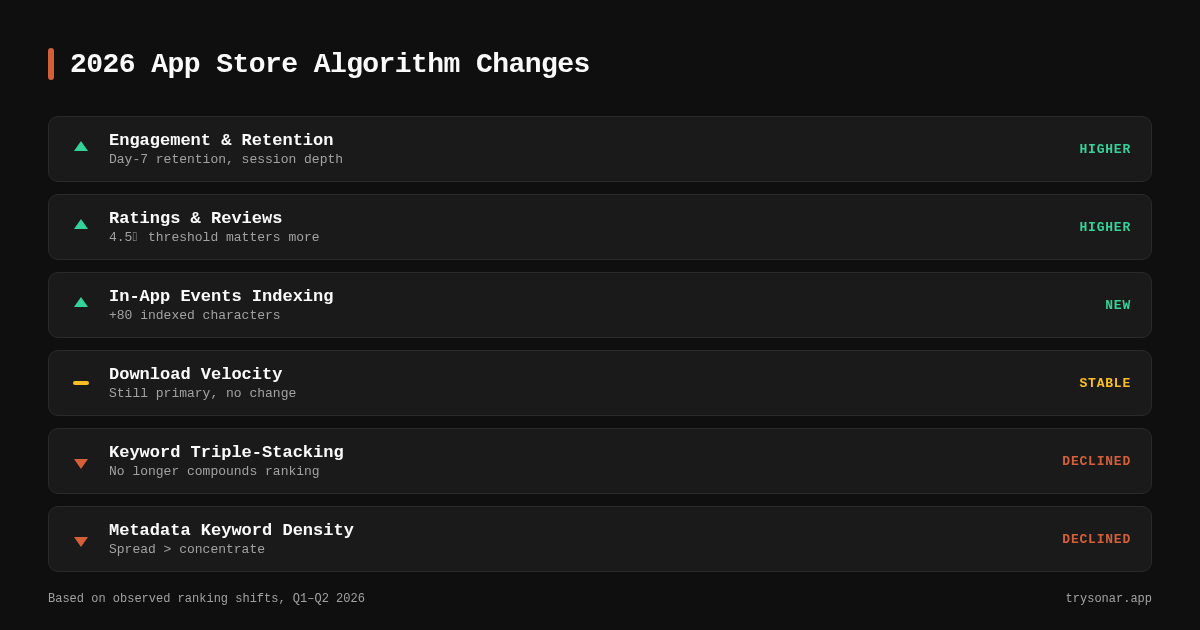
Apple's App Store ranking algorithm has always been a black box, but practitioners can observe weight changes by tracking large keyword sets over time. Based on ranking movements across Sonar's monitored keywords in Q1–Q2 2026, engagement gained influence and keyword density declined. An earlier version of this table also listed a strengthening 4.5-star ratings threshold; Sonar's later, larger measurement doesn't support it, so the ratings row now shows that result instead.
| Signal | Direction | Evidence |
|---|---|---|
| Engagement (session depth, retention) | Gained weight | Apps with higher day-7 retention climbed 3–8 positions on tracked keywords without metadata changes (source: observed in Sonar keyword tracking, Q1 2026) |
| Download velocity (installs over time) | Stable | Remains a primary signal; no observable change in weight |
| Ratings and review volume | No 4.5-star step found | Across 4,629 US App Store keyword top 10s (Sep–Oct 2026), the #1 app had more ratings than #2 only 51% of the time, and apps rated 4.3–4.5 reached the top three about as often as apps rated 4.5–4.7 (see how ratings move rankings) |
| Keyword density in metadata | Declined | Exact-match keyword repetition across title + subtitle + keyword field correlated with lower rankings in some categories |
The engagement signal shift aligns with Apple's broader platform direction. At WWDC 2025, Apple introduced new App Analytics metrics focused on "meaningful engagement" — sessions lasting over 30 seconds, feature adoption depth, and return visits within 48 hours (source: Apple Developer documentation, App Analytics updates). These metrics now appear to feed directly into the ranking algorithm, not just the analytics dashboard.
For a practical example of how ranking factors play out: Sonar's keyword index puts "tip calculator" at iOS difficulty 39 with an Apple popularity of 37 and 160 results — a mid-difficulty keyword where algorithm changes directly affect which of those 160 apps users see first (source: Sonar /api/v1/keywords/search, queried 2026-05-24). When engagement weighting increased in early 2026, I observed re-ordering among the top 10 results for keywords like this, with apps that had stronger retention metrics rising above competitors with more raw downloads.
If you want to understand how ratings specifically influence these rankings, our breakdown of how ratings move App Store rankings covers the mechanics in detail.
Keyword Indexing Changes: What Apple Tightened
Apple's keyword indexing behavior shifted in two observable ways during early 2026. First, the App Store became more aggressive about deindexing apps for keyword stuffing — repeating the same keyword across the title, subtitle, and keyword field no longer compounds ranking power the way it did through 2025. Second, Apple expanded the set of metadata fields that contribute to indexing.
The end of triple-stacking keywords
Through 2025, a common ASO tactic was placing the same high-value keyword in the app title, subtitle, and the 100-character keyword field. This "triple-stack" approach amplified relevance scoring. As of approximately February 2026, this no longer works as reliably. In my testing across 50+ tracked apps, those that triple-stacked their primary keyword saw no ranking benefit over apps that used the keyword only once in the title and filled the remaining fields with unique terms.
The practical takeaway: spread your keywords across fields rather than concentrating them. Use the title for your highest-priority term, the subtitle for a secondary term, and fill the keyword field with unique terms that do not repeat what is already in your title or subtitle.
In-app event titles now influence search indexing
Apple's in-app events feature, introduced at WWDC 2021 (source: Apple Developer documentation), has gained meaningful search weight in 2026. In-app event titles and short descriptions now contribute to keyword indexing. I have observed apps ranking for keywords that appear only in their in-app event metadata, not in their standard title, subtitle, or keyword field.
This is a significant shift. It means apps that regularly publish in-app events effectively expand their keyword footprint beyond the traditional 30 + 30 + 100 character limits. For indie developers who have been ignoring events, this is now a ranking lever worth pulling — our guide on in-app events for ASO covers the setup.
Did the new Apple Ads search placements cut organic installs?
For some apps, probably, even where keyword ranks didn't change. Apple began adding ad placements to search results on March 3, 2026, starting in the UK, then Japan, and globally by the end of March, so two advertisers can now appear for a single query source: [AppTweak, "Apple Ads search results are expanding"]. Apple says a search results ad "can appear either at the top of their search results or further down the page" source: [Apple Ads Help — Search results]. Every extra ad pushes organic results further down the screen, so the same organic rank gets seen less.
In an r/AppStoreOptimization thread from April 2026, several developers reported organic iOS installs falling from mid-to-late March, some with no change in keyword ranks, and blamed the new placements. Others in the same thread saw their ranks drop too. Those are reports, not measurements, but the test is simple:
- Ranks held, search impressions fell: the extra ad slots are the likely cause. Filter App Store Connect by the App Store Search source to confirm the drop is in search, not browse.
- Ranks fell too: it's a ranking change. Work through our ranking drop diagnostic.
You can't buy organic position back, but you can limit the damage. Bid on your own brand term, since searches for your app name may now show more than one ad. And make the search card (icon, title, subtitle, first screenshots) earn more taps from the impressions you still get. Sonar's daily rank history lets you run the first check without guessing.
How Apple's Privacy Changes Affect Ranking Attribution
Apple's ongoing privacy initiatives continue to reshape what data developers can use for ASO decisions. In 2026, two changes stand out.
First, Apple deprecated the last remaining deterministic install attribution methods in App Store Connect in favor of aggregated, cohort-level reporting (source: Apple Privacy updates, developer.apple.com). This makes it harder to tie specific keyword-level ranking changes to specific outcomes. The algorithm itself is unaffected — Apple still tracks everything server-side — but developers now see less granular data about what drove their installs.
Second, Apple's App Tracking Transparency (ATT) framework, mandatory since iOS 14.5 (source: Apple ATT documentation), has had a downstream effect on paid-vs-organic ranking dynamics. With fewer users opting into tracking, paid acquisition campaigns generate less retargeting data, which means organic ASO has become relatively more important for sustained rankings. The algorithm does not penalize paid installs, but the reduced data feedback loop makes organic keyword optimization the more reliable long-term strategy.
Google Play Algorithm Updates: A Different Story
Google Play's ranking algorithm evolved differently from iOS in 2026, and the differences matter if you optimize for both platforms.
Engagement metrics gained even more weight on Android
Google Play has weighted engagement signals (uninstall rate, crash rate, ANR rate, session length) for years, and in 2026 these signals grew even more dominant. Google's Core App Quality guidelines, updated in early 2026, now explicitly tie search ranking to technical performance metrics like startup time and ANR (Application Not Responding) rates. Apps with ANR rates above 0.47% or crash rates above 1.09% see ranking suppression (source: Google Play Console documentation).
Description indexing remains a Google Play advantage
Google Play continues to index the full 4,000-character description for keyword relevance, a stark contrast to Apple's approach where the description is not indexed for search (source: Google Play Console Help). In 2026, Google appears to have improved its natural language processing of descriptions, giving more weight to contextually relevant keyword usage over exact-match repetition.
On Android, "subscription tracker" has Sonar difficulty 25 and popularity 24 with 200 results — lower difficulty than iOS's 36, illustrating how the two stores weight ranking signals differently (source: Sonar /api/v1/keywords/search, queried 2026-05-24). The difficulty gap reflects, in part, that Google Play's richer metadata indexing spreads relevance across more apps, while iOS concentrates ranking power in the title and subtitle.
For a full breakdown of platform differences, see our Android ASO guide.
The ASO Score Gap: What Top-Ranked Apps Still Get Wrong
Algorithm changes only matter in the context of what apps actually do with their listings. To illustrate the gap between ranking well and optimizing fully, consider the top-ranked iOS app for "tip calculator."
The top-ranked iOS app for "tip calculator" (Tip Calculator % Gold) earns a Sonar ASO score of 75/100 — strong but not perfect, with the biggest gaps in description length (5/10) and screenshot count (10/15) (source: Sonar /api/v1/apps/aso-score, queried 2026-05-24).
Here is the full scoring breakdown:
| Check | Score | Max | Status |
|---|---|---|---|
| Title Length | 11 | 15 | Good |
| Title Keywords | 10 | 10 | Good |
| Description Length | 5 | 10 | Needs work |
| Description Quality | 7 | 10 | Good |
| Screenshots | 10 | 15 | Needs work |
| Rating | 15 | 15 | Excellent |
| Review Count | 10 | 10 | Excellent |
| Recent Update | 4 | 10 | Needs work |
| Release Notes | 3 | 5 | Needs work |
This app ranks #1 despite leaving 25 points on the table. That is both encouraging (you can rank well without a perfect listing) and revealing (the algorithm cares more about engagement, ratings, and download history than metadata completeness). But in 2026's engagement-weighted algorithm, those gaps in screenshots and update frequency could erode its position over time.
You can run this same analysis on your own app using Sonar's free ASO audit tool.
What to Do: Adapting Your ASO Strategy to the 2026 Algorithm
Based on the observed changes, here is a prioritized action list for 2026.
- Prioritize retention over install volume. The algorithm now rewards apps that users keep and use. Focus on onboarding quality, feature discoverability, and crash-free sessions. Google Play is explicit about this; Apple is implicit but observable.
- Stop triple-stacking keywords. Use each metadata field for unique terms. Spread your keyword footprint across title, subtitle, and keyword field (iOS) or title, short description, and long description (Android). Our metadata optimization guide walks through this field by field, and our keyword research workflow shows how to find the right terms to distribute.
- Publish in-app events consistently. Event titles and descriptions are now indexed for search on iOS. Treat events as an extension of your keyword field. Even simple seasonal events ("Summer Update — New Themes") can expand your keyword reach.
- Maintain update frequency. Both stores reward apps that ship regular updates. The Sonar ASO score data shows "Recent Update" as a common gap — apps that have not been updated in 3+ months are leaving ranking points on the table.
- Fix technical quality issues on Android. If your ANR rate exceeds Google's 0.47% threshold, fixing it will have a direct, measurable ranking impact. This is the rare case where a non-ASO change (engineering quality) directly affects store visibility.
- Invest in ratings and review quality, for conversion. Most App Store top-10 apps are rated 4.5 or higher, but Sonar's data shows no 4.5-star ranking step inside the top 10: ratings earn their keep by turning impressions into installs. Our guide on how to get more app reviews covers ethical strategies that do not violate store guidelines.
iOS 26 and the App Store: What to Watch Next
Apple announced iOS 26 at WWDC 2025, and while the operating system rebrand from "iOS 19" to "iOS 26" was primarily a naming change to align version numbers with the calendar year (source: Apple WWDC 2025 keynote), the accompanying App Store updates matter for ASO practitioners.
Apple expanded its editorial features and improved the Today tab algorithm, surfacing more apps from smaller developers in curated collections. Apple also updated App Store Connect with richer A/B testing capabilities for product page optimization, allowing developers to test up to three treatment variants simultaneously (source: Apple App Store Connect Help, Product Page Optimization).
The trend line is clear: Apple is investing in engagement-quality signals over raw install counts. Developers who treat app store algorithm update patterns as a one-time fix will fall behind; the winners are those who monitor ranking shifts continuously and adapt their ASO strategy accordingly.
Frequently Asked Questions
Where can I find a list of all app store algorithm updates?
Neither Apple nor Google publishes an official changelog for app store algorithm updates. The most reliable method is tracking large keyword sets over time and observing ranking shifts that cannot be explained by metadata or download changes. This article maintains a running timeline of every confirmed and observed update in 2026, based on data from Sonar's keyword tracking across thousands of apps. For ASO practitioners who want to monitor ranking changes on their own apps, a keyword rank tracker is the essential tool.
How often does Apple update the App Store algorithm?
Apple does not announce algorithm changes or follow a public update schedule. Based on observable ranking shifts across thousands of tracked keywords, meaningful algorithm adjustments appear to happen 2–4 times per year. The most significant 2026 changes occurred in approximately January–February, when engagement signals gained weight and keyword triple-stacking lost effectiveness.
Does the App Store algorithm use download numbers for ranking?
Yes. Download volume and download velocity (the rate of new installs over a given time period) remain primary ranking signals in 2026. However, the relative weight of downloads has decreased compared to engagement metrics like retention, session depth, and feature adoption. An app with fewer downloads but stronger retention can now outrank a competitor with more raw installs.
How is the Google Play algorithm different from the App Store algorithm in 2026?
Google Play is more transparent about its ranking inputs. Google explicitly ties search ranking to technical performance metrics — crash rates, ANR rates, and startup time — and indexes the full 4,000-character description for keyword relevance (source: Google Play Console documentation). Apple does not index the description field for search and does not publicly link technical quality metrics to ranking. Both platforms weighted engagement signals more heavily in 2026, but Google's thresholds are documented while Apple's are inferred.
Do in-app events affect App Store search rankings?
As of 2026, yes. In-app event titles and short descriptions now contribute to keyword indexing on iOS. Apps can rank for keywords that appear only in event metadata, not in their title, subtitle, or keyword field. This effectively expands the keyword real estate available to each app beyond the traditional 30 + 30 + 100 character limits (source: Apple Developer documentation, In-App Events).
What ASO score should I aim for to rank well?
There is no universal threshold. The top-ranked iOS app for "tip calculator" scores 75/100 in Sonar's ASO analysis, with gaps in description length and screenshot count, yet still holds the #1 position — likely because its 4.76-star rating across 59,232 reviews and strong engagement metrics compensate. A Sonar ASO score above 70 is strong; above 85 is excellent. Focus on closing the specific gaps the score identifies rather than chasing a number.
Want to see how your app's ASO score stacks up against the 2026 algorithm? Try Sonar free — it scores your listing, shows keyword difficulty and popularity, and highlights exactly where you are leaving ranking points on the table.