Apple Search Ads vs Organic ASO: A Data-Driven Decision Framework
Every app developer eventually faces this question: spend money on Apple Search Ads, or invest time into organic App Store Optimization? The answer depends on your keyword landscape, budget runway, and competitive position — not on a blanket "always do both" platitude.
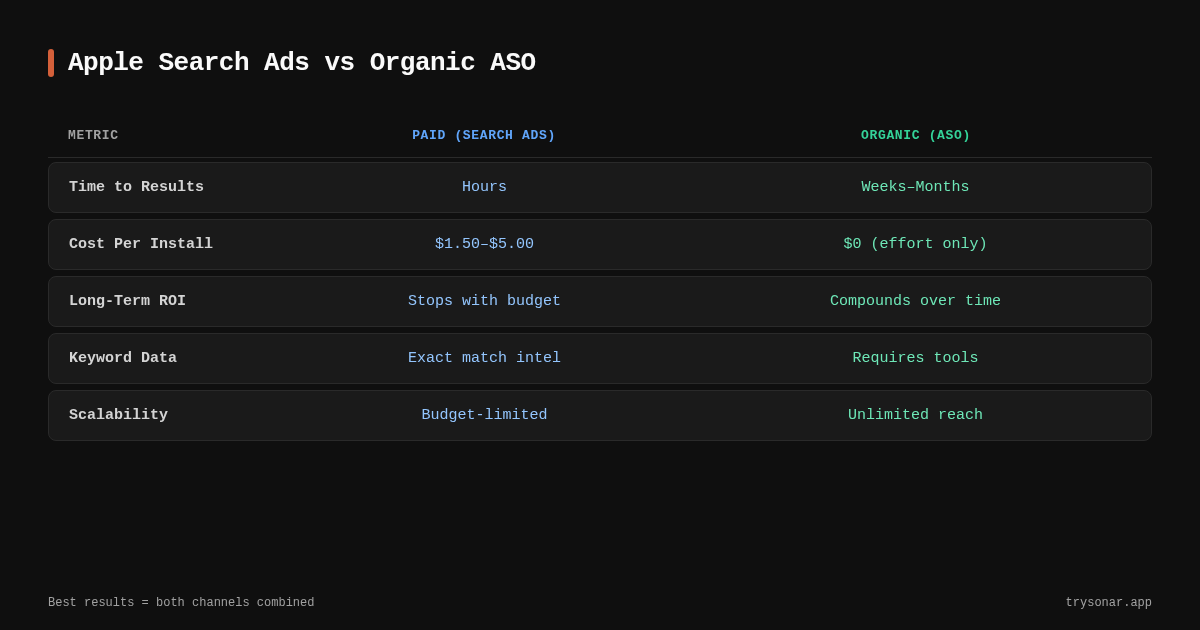
Here is the reality. Apple Search Ads gives you placement at the top of App Store search results within hours. Organic ASO takes weeks or months to move the needle but costs nothing per tap once you rank. The smart play is knowing exactly when each approach earns its keep.
How Apple Search Ads Actually Works
Apple Search Ads operates on a cost-per-tap (CPT) auction model. You bid on keywords, and Apple displays your ad above organic results when a user searches that term. Apple reports an average CPT of $2.07 across all categories as of Q3 2024 [source: searchads.apple.com/best-practices]. Some categories — finance, insurance, gaming — run far higher.
There are two tiers:
| Feature | Search Ads Basic | Search Ads Advanced |
|---|---|---|
| Targeting | Automatic | Manual keyword/audience |
| Budget minimum | None (pay per install) | None (pay per tap) |
| Reporting | Install counts only | Full funnel metrics |
| Creative control | None | Custom ad variations |
Basic is a "set budget and forget" model. Advanced gives you keyword-level bidding, audience refinement by demographics and device, and creative A/B testing. For most indie developers making strategic keyword decisions, Advanced is where the actionable data lives.
If you want a deeper walkthrough of campaign structure, bidding logic, and budget allocation, see our complete Apple Search Ads guide.
How Organic ASO Drives Installs Without Ad Spend
Organic ASO means optimizing your app's metadata — title, subtitle, keyword field, description, screenshots — so the App Store algorithm ranks you higher for relevant searches. Apple's algorithm weighs keyword relevance, conversion rate, velocity of downloads, and ratings [source: developer.apple.com/app-store/search/].
The compounding advantage: once you rank #1–#3 for a keyword organically, every tap is free. No daily budget caps. No CPT inflation from competitors bidding up auctions. The tradeoff is time and iteration. Moving from position #40 to position #5 might take 3–6 update cycles depending on competition.
For the mechanics of choosing and placing keywords, our keyword field guide covers what Apple actually indexes and what gets ignored.
When to Pay: Scenarios That Favor Apple Search Ads
1. Branded Competitor Terms
If users search a competitor's name and you offer a direct alternative, organic ranking is nearly impossible — the competitor's exact-match title dominates. Bidding on their brand term via Apple Search Ads is often the only path to visibility.
2. High-Difficulty Keywords You Cannot Crack Organically
Take "habit tracker" — a query App Store users actually run, not a meta term. Sonar rates it at difficulty 67 on iOS with a popularity of 55, meaning there is real, sustained search demand but ranking against entrenched apps like Streaks and Productive is brutally hard. For keywords above difficulty 60 with popularity above 40 — high demand colliding with high competition — Apple Search Ads is often the only way to claim a top-3 position unless you already have download velocity behind you.
Google Play shows similar pressure: "habit tracker" sits at difficulty 62 with popularity 52 in Sonar's index. The numbers are close because both stores have mature productivity ecosystems competing for the same query. When difficulty and popularity both run high on a category-defining term, paying for the auction is faster than waiting out the organic queue.
3. Launch Windows
New apps have zero download history, zero ratings, and no ranking momentum. Apple Search Ads solves the cold-start problem by generating initial installs that feed the organic algorithm. Apple has stated that 65% of App Store downloads come from search [source: searchads.apple.com]. Capturing even a fraction of that during launch week accelerates your organic trajectory.
4. Validating Keyword Intent Before Committing Metadata
Running a 7-day Search Ads campaign on a keyword costs less than the time spent on a full metadata update cycle. If the keyword converts at >40% tap-through rate and >25% conversion rate, it belongs in your organic strategy. If it flops, you saved yourself a wasted update.
5. Seasonal or Event-Driven Spikes
Tax season, back-to-school, holiday shopping — these demand windows are too short for organic ranking cycles. Paid ads let you capture intent immediately during a 2–4 week window.
When to Optimize: Scenarios That Favor Organic ASO
1. Low-to-Medium Difficulty Keywords
Take "color picker" — a utility query App Store users run when they need a quick design tool. Sonar rates it at difficulty 25 on iOS with popularity 20, and even lower on Google Play: difficulty 17 with popularity 41. That combination — meaningful search volume with weak competition — is exactly the kind of opportunity organic metadata can capture without ever opening a Search Ads campaign. Keywords below difficulty 50 with popularity above 15 are prime organic targets, where a tight title and a well-packed keyword field will move you into the top 5 within a few update cycles.
Our guide on finding low-competition keywords walks through the process of identifying these opportunities systematically.
2. Long-Tail Keywords With Clear Intent
Three-to-five-word phrases like "budget tracker for freelancers" or "meditation timer no subscription" carry strong intent and low competition. Apple indexes your 100-character keyword field, your 30-character title, and your 30-character subtitle [source: developer.apple.com/app-store/product-page/]. Packing long-tail terms into these fields costs nothing and often delivers conversions that match or beat paid campaigns.
3. When Your Conversion Rate Is Already Strong
If your app page converts at 30%+ from impression to install, every organic impression is highly efficient. Pouring money into ads when your organic conversion is already strong means you are paying for users you might have gotten free. Focus ad spend on keywords where you have zero organic presence.
4. Budget Constraints Beyond $500/Month
Apple Search Ads gets expensive fast. At $2.07 average CPT and a 50% conversion rate from tap to install, each install costs roughly $4.14. At $500/month, that is ~120 installs. Organic ASO, once optimized, delivers installs indefinitely at zero marginal cost. Developers with tight budgets should treat paid ads as a research tool, not a growth engine.
5. Building Sustainable Rankings for Core Terms
Organic rankings compound. An app that ranks #3 for "habit tracker" today — assuming it maintains download velocity and conversion — will likely still rank #3 next month without any additional spend. Ads stop the moment your budget runs out.
The Hybrid Strategy: Using Ads to Fuel Organic
The most effective approach is not either/or — it is sequential.
Phase 1: Discovery (Weeks 1–2) Run Apple Search Ads on 20–30 candidate keywords with a $20/day budget. Measure tap-through rate, conversion rate, and cost per acquisition.
Phase 2: Organic Targeting (Weeks 3–6) Take the top 5–8 converting keywords from Phase 1. Insert them into your title, subtitle, and keyword field. Update screenshots and descriptions to match search intent.
Phase 3: Paid Reinforcement (Ongoing) Keep ads running only on high-difficulty keywords where you cannot crack the top 5 organically. Cut spend on any keyword where you reach organic position #1–#3.
Phase 4: Measurement Track organic rank movement weekly using a keyword rank tracker. If your organic position improves after 2–3 update cycles, reduce ad spend on that term by 50% and measure install volume change.
This loop turns Apple Search Ads from a cost center into a keyword research engine that feeds your organic machine.
Cost Comparison: A Realistic Model
Consider a productivity app targeting 10 keywords:
| Metric | Apple Search Ads Only | Organic ASO Only | Hybrid |
|---|---|---|---|
| Monthly spend | $1,500 | $0 (time investment) | $600 |
| Installs/month (est.) | 360 | 200–800* | 500–900 |
| Cost per install | $4.17 | $0 marginal | $0.67–$1.20 |
| Time to first results | 1 day | 4–8 weeks | 1–8 weeks |
| Sustainability without spend | None | High | Medium-High |
*Organic range depends on keyword difficulty and app page conversion rate.
The hybrid model typically delivers the best unit economics because paid installs boost organic velocity, which then reduces the need for continued paid spend.
Measuring What Works: Key Metrics
Track these numbers to decide whether to shift budget toward ads or optimization:
- Tap-through rate (TTR) from Search Ads — below 5% means your creative or relevance is weak
- Conversion rate (CR) on your product page — below 20% signals a page problem, not a traffic problem
- Organic keyword rank — use tools that track daily position changes
- Share of voice — what percentage of impressions you capture vs. competitors
- Cost per acquisition (CPA) — when CPA exceeds customer lifetime value, cut the keyword
For a full breakdown of which ASO metrics matter and which are vanity, see our ASO KPIs guide.
Platform Differences: iOS vs Google Play
Apple Search Ads exists only on iOS. Google Play has its own ad system (Google Ads Universal App Campaigns), but the organic ASO mechanics differ substantially between platforms.
On iOS, the keyword field is a hidden 100-character string. On Google Play, keywords are extracted from your full 4,000-character description [source: support.google.com/googleplay/android-developer/answer/9898842]. This means organic ASO on Google Play has more surface area — and more room for error.
The competitive dynamics also differ by keyword. Sonar data confirms this: "meditation timer" runs at difficulty 61 on iOS but just 36 on Google Play — near-identical popularity (42 vs 41), nearly half the competition on Android. The same keyword that demands a paid push on iOS may be wide open organically on Google Play. If you operate on both platforms, do not assume a single keyword strategy transfers.
Our iOS vs Google Play ASO comparison covers these structural differences in detail.
Common Mistakes
Mistake 1: Running ads without tracking organic rank. If you do not know whether ads are cannibalizing organic installs, you are potentially paying for traffic you already earned.
Mistake 2: Ignoring keyword difficulty before choosing a strategy. A difficulty-80 keyword demands paid placement. A difficulty-30 keyword is wasted ad budget. Check difficulty scores before allocating spend.
Mistake 3: Optimizing metadata for high-difficulty branded terms. Trying to rank organically for "spotify" or "tiktok" is futile. Reserve metadata real estate for keywords you can realistically crack.
Mistake 4: Treating Search Ads as a set-and-forget channel. CPT bids shift weekly. Competitors enter and exit auctions. Review campaign performance every 7 days minimum.
FAQ
How much should I spend on Apple Search Ads as a new developer?
Start with $20–$50/day across 15–20 keywords for a 2-week discovery phase. This gives you statistically meaningful data on tap-through and conversion rates without burning through runway. Scale spend only on keywords that convert below your target CPA threshold.
Can Apple Search Ads improve my organic rankings?
Yes, indirectly. Apple's algorithm factors in download velocity when calculating organic rank. A burst of paid installs signals relevance to the algorithm, which can boost your organic position for the same keyword. This effect is most pronounced during launch or after a major update.
Should I bid on my own brand name in Apple Search Ads?
If competitors are bidding on your brand name, yes — defensive bidding prevents them from siphoning users who already intend to download your app. If no one is bidding on your brand, organic ranking for your own name should be automatic and ads are unnecessary. Check the "Impressions" column for your brand keyword to see if competitors are active.
What is a good conversion rate for Apple Search Ads?
The App Store average conversion rate from tap to install is roughly 50% across all categories [source: searchads.apple.com/best-practices]. Below 30% suggests your product page needs work — better screenshots, a clearer value proposition, or stronger ratings. Above 60% means your keyword targeting is well-aligned with your app's offering.
How long does organic ASO take to show results?
Expect 2–4 weeks for Apple to fully re-index your metadata after an update. Meaningful rank movement — climbing from position #50 to top-10 — typically requires 2–3 update cycles (6–12 weeks) with sustained download activity between updates. Low-difficulty keywords move faster; high-difficulty keywords may take 4+ months.
Looking for keyword difficulty scores, search volume estimates, and competitive intel before you decide where to spend? Try Sonar free — it shows difficulty, popularity, and competitor data for every App Store keyword so you can make the pay-vs-optimize decision with real numbers.