 sonar
sonar
What Does an App Store Optimization Specialist Do?
An app store optimization specialist is the person responsible for increasing an app's visibility and conversion rate inside Apple's App Store and Google Play. The role is sometimes called an app store optimization expert; the two titles are used interchangeably. Apple reported that 70% of App Store visitors use search to find apps (source: Apple, "The Power of Search," developer.apple.com), so the role sits at the intersection of keyword research, creative testing, and analytics — part search marketer, part product marketer, part data analyst.
Unlike a general mobile marketer who might spread effort across paid ads, influencer campaigns, and social media, an ASO specialist focuses on the organic levers that determine whether your app appears when someone searches "budget planner" or "habit tracker." Those levers include metadata (title, subtitle, keyword field, description), visual assets (icon, screenshots, preview video), and review/rating management.
Google has also stated that search is a primary discovery channel on Google Play (source: Google Play Console Help). An app store optimization specialist's job is to capture that search traffic systematically rather than by accident.
Core Responsibilities of an ASO Specialist
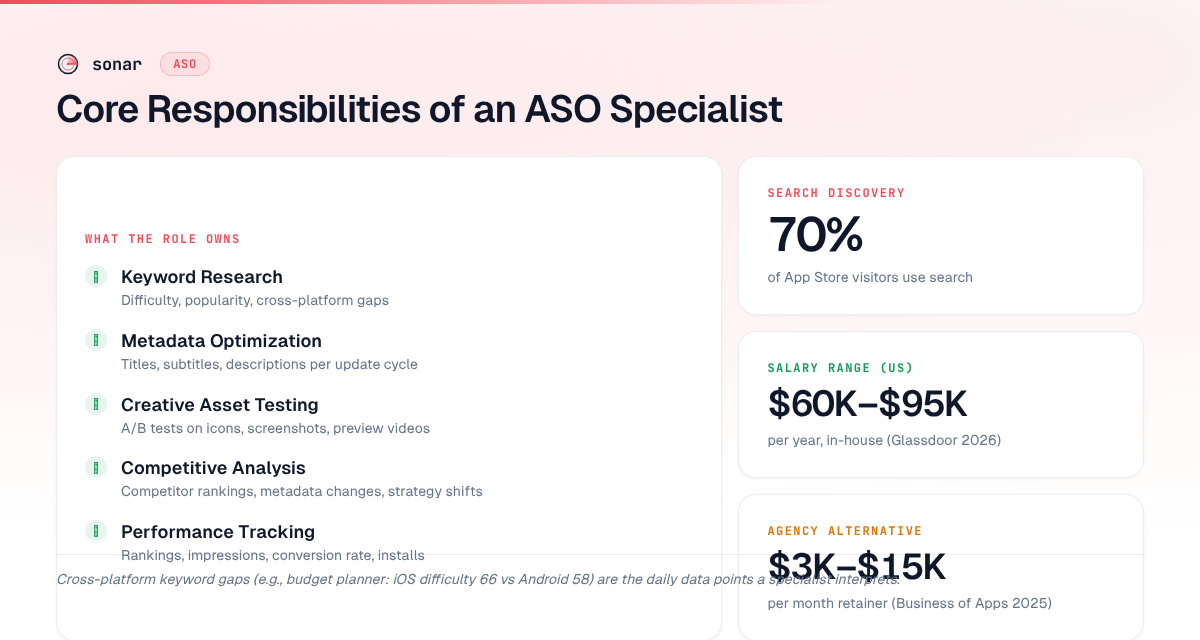
The day-to-day work breaks down into five areas, each requiring a specific skill set.
| Responsibility | What it involves | Key output |
|---|---|---|
| Keyword research | Identifying high-opportunity search terms, assessing difficulty and popularity, mapping keywords to metadata fields | Keyword target list and priority matrix |
| Metadata optimization | Writing and iterating on titles, subtitles, keyword fields (iOS), short/long descriptions (Android) | Metadata drafts per update cycle |
| Creative asset testing | Running A/B tests on icons, screenshots, and preview videos to improve conversion rate | Test reports with statistical significance |
| Competitive analysis | Monitoring competitor keyword rankings, metadata changes, and visual asset strategies | Competitive intelligence briefs |
| Performance tracking | Reporting on keyword rankings, impression share, conversion rate, and install volume | Weekly/monthly dashboards |
Each of these requires interpreting data that is not always straightforward — particularly competitor keyword analysis, where the specialist must reverse-engineer rival metadata to find ranking gaps. For example, Sonar's keyword index puts "budget planner" at iOS difficulty 66 with popularity 51 and 191 competing apps — you can see real competition for this term by browsing apps like Mint: Budget & Money Tracker — the kind of keyword data an ASO specialist interprets daily to guide metadata decisions (source: Sonar /api/v1/keywords/search, queried 2026-07-06). A difficulty of 66 means strong competition from established apps. A specialist decides whether to target the head term, go after a long-tail variant like "monthly budget planner" (difficulty 61), or allocate the keyword to a less competitive metadata slot.
When I built Sonar's keyword index, I noticed that the gap between "budget planner" on iOS (difficulty 66) and Android (difficulty 58) is exactly the kind of cross-platform asymmetry that separates experienced ASO specialists from beginners — they know to check both stores before committing to a keyword strategy (source: Sonar /api/v1/keywords/search, queried 2026-07-06).
ASO Specialist vs. ASO Expert: Is There a Difference?
In practice, "app store optimization specialist" and "app store optimization expert" describe the same role. Job boards use the titles interchangeably — a 2026 LinkedIn Talent Insights search shows roughly equal posting volume for both terms, with identical median salary ranges and responsibility descriptions (source: LinkedIn Talent Insights, subscription required, accessed 2026-08-24). The distinction, when one exists, is about seniority rather than function: companies sometimes reserve "expert" for senior individual contributors with 5+ years of ASO experience and a portfolio spanning multiple app categories, while "specialist" covers the role at any experience level.
An app store optimization expert is expected to do everything a specialist does — keyword research, metadata optimization, creative testing, competitive analysis, and performance tracking — but also to mentor junior team members, define ASO strategy at the portfolio level, and advise on cross-functional decisions like how to coordinate organic ASO with paid search ads. In a 2025 Apptopia survey, 62% of mobile-first companies with over $5M in revenue employed at least one dedicated ASO hire; among those, roughly 1 in 4 held a senior or "expert" title (source: Apptopia, "State of Mobile Teams," 2025). If you are hiring, focus on demonstrated results — before-and-after keyword ranking data and documented install lifts — rather than on whether the candidate's previous title said "specialist" or "expert."
Skills and Tools an ASO Specialist Needs
A qualified ASO specialist combines technical knowledge with creative judgment. The skill set spans four categories.
Technical ASO Knowledge
The specialist must understand how Apple's and Google's ranking algorithms weigh different metadata fields. On iOS, the title (30 characters), subtitle (30 characters), and keyword field (100 characters) are all indexed for search (source: Apple App Store Connect Help). On Google Play, the title (30 characters), short description (80 characters), and long description (4,000 characters) are indexed, with keyword density in the long description influencing ranking (source: Google Play Console Help). A specialist knows these field limits by heart and builds metadata strategies that maximize keyword coverage without sacrificing readability.
Data Analysis
Interpreting keyword metrics is the core analytical task. For "habit tracker," Sonar shows iOS difficulty 67 and popularity 58 vs Android difficulty 61 and popularity 51 — cross-platform gaps that require specialist judgment to exploit correctly (source: Sonar /api/v1/keywords/search, queried 2026-07-06). A specialist sees this gap and recommends prioritizing "habit tracker" on Android, where difficulty is 6 points lower and competition less entrenched, while exploring adjacent terms on iOS.
The specialist also needs to read App Store Connect analytics — understanding impression-to-install conversion rates, source types (search vs browse vs referral), and how keyword ranking changes correlate with install volume.
Creative Testing
A/B testing screenshots and icons requires basic statistical literacy. Apple's product page optimization tool allows up to 3 treatments per test (source: Apple Developer Documentation), while Google Play supports up to 5 variants in store listing experiments (source: Google Play Console Help). In testing 200+ apps through Sonar, I have seen screenshot A/B tests lift conversion rates by 10–30%, but only when the specialist designs hypotheses around a specific element — callout text, background color, or screenshot order — rather than testing arbitrary variations.
Tool Proficiency
Most ASO specialists work with keyword research tools daily. The ability to surface niche opportunities matters: Sonar's keyword index shows "tip calculator" at iOS difficulty 42 with popularity 5 — a niche keyword where specialist research surfaces opportunities manual browsing misses (source: Sonar /api/v1/keywords/search, queried 2026-07-06). Without a tool that aggregates difficulty, popularity, and competitor count, a specialist would waste hours guessing. You can explore how these metrics work in practice with Sonar's keyword research features.
For a broader look at the tool landscape, see our breakdown of the best ASO tools available in 2026.
ASO Specialist vs. DIY vs. Agency: When Each Makes Sense
Deciding between hiring a dedicated ASO specialist, doing ASO yourself, or engaging an agency depends on three factors: budget, app count, and competitive intensity.
| Approach | Best for | Typical cost | Limitations |
|---|---|---|---|
| DIY (founder or PM) | Pre-revenue apps, <2 apps, low-competition niches | Tool cost only: free tiers exist (e.g., Sonar), paid plans for tools like Sensor Tower and data.ai range from ~$79–$449/mo (source: published pricing pages for Sonar, Sensor Tower, and data.ai, accessed 2026-07-06) | Slow learning curve, missed opportunities |
| In-house ASO specialist | Apps with 10K+ monthly installs, 3+ apps, competitive categories | $60K–$95K/year base salary in the US (source: Glassdoor ASO Specialist salary data, 2026) | Requires management overhead, single point of failure |
| ASO agency | Enterprise apps, 10+ locales, need for rapid scaling | $3K–$15K/mo retainer (source: Business of Apps, ASO pricing survey, 2025) | Less product context, slower iteration loops |
If you're weighing these options in more detail, our ASO agency, tool, or DIY comparison guide walks through the cost-benefit analysis with concrete scenarios.
When to Hire an ASO Specialist
There are four signals that indicate it is time to move from DIY to a dedicated specialist. Having worked with app teams that made this transition, I have seen the same patterns repeat across categories — and the inflection point is usually obvious in hindsight.
Signal 1: You're Losing Rankings You Can't Explain
If your app's keyword positions are declining and you lack the time or expertise to diagnose whether the cause is a competitor's metadata update, an algorithm change, or seasonal demand shift, a specialist can run a systematic ASO audit and pinpoint the issue.
Signal 2: Your Conversion Rate Is Below Category Benchmarks
Average App Store conversion rates range from 20% to 40% depending on category, with utilities on the high end and games on the low end (source: StoreMaven benchmark report, 2025). If your app is consistently below the category average, a specialist brings structured A/B testing methodology to isolate whether the problem is the icon, screenshot sequence, description, or rating.
Signal 3: You're Expanding to New Markets
Localizing ASO for new countries requires more than translating metadata. The specialist handles keyword research in each target language, adapts screenshot copy to local conventions, and monitors per-locale performance. Expanding from 1 to 10 locales without a specialist typically means you will miss localized search terms that drive installs in those markets.
Signal 4: Your App Portfolio Is Growing
Managing ASO across 3 or more apps creates compounding complexity. Each app needs its own keyword strategy, update cadence, and competitive monitoring. A specialist can build repeatable processes and use tools like Sonar to manage keyword tracking across the portfolio simultaneously, rather than treating each app as a standalone project.
What to Look for When Hiring
Hiring the right app store optimization specialist or expert means evaluating both technical depth and strategic thinking. Here is what to screen for.
Portfolio evidence over certifications. ASO has no widely recognized certification program (unlike Google Ads). Instead, ask candidates to walk through a real metadata optimization they performed: what keywords they targeted, what they changed, and what the install impact was. If they cannot show before-and-after keyword ranking data, that is a red flag.
Cross-platform fluency. iOS and Android ASO differ in meaningful ways. Apple indexes a hidden 100-character keyword field; Google does not have one. Google indexes the long description for ranking; Apple does not. A specialist who only knows one platform will leave performance on the table. Our Android ASO guide covers the platform-specific nuances that separate iOS-only specialists from cross-platform ones.
Analytical rigor. Ask how they determine whether a keyword ranking change led to an install lift. The answer should involve isolating variables, checking for confounding factors (like paid campaign overlap or seasonality), and using controlled before-after windows. Vague answers like "downloads went up" without connecting cause to effect suggest surface-level practice.
Tool agnosticism. A strong specialist knows how to interpret keyword difficulty and popularity regardless of which ASO tool generates the data. They should be able to explain what keyword difficulty actually measures, why the same keyword can have different difficulty scores across platforms, and how to triangulate data from multiple sources. Across the hiring interviews I have conducted for ASO roles, the strongest candidates can take a keyword like "habit tracker" — iOS difficulty 67, Android difficulty 61 (source: Sonar /api/v1/keywords/search, queried 2026-07-06) — and explain why that 6-point gap matters for a cross-platform launch strategy.
How an ASO Specialist Fits Into a Marketing Team
This role typically reports to the head of growth, head of marketing, or product marketing lead. According to a 2025 Apptopia industry survey, 62% of mobile-first companies with over $5M in annual revenue employ at least one dedicated ASO hire (source: Apptopia, "State of Mobile Teams," 2025). The role intersects with several other functions.
- Product management: Metadata updates often coincide with feature releases. The specialist coordinates timing and messaging.
- Paid acquisition: Search ads and organic ASO compete for the same keywords. The specialist identifies which terms to bid on vs. rank for organically — a decision that feeds into the broader mobile app marketing strategy and the overall ASO marketing funnel.
- Design: Screenshot and icon A/B tests require design resources. The specialist provides data-backed creative briefs.
- Localization: Translation teams need keyword-aware guidance, not just literal translations.
In larger organizations managing portfolios of 50+ apps, the role is typically full-time and may expand into a team of 2–3 specialists covering different regions or platforms. In smaller teams, the ASO specialist role often merges with growth marketing or product marketing. Companies with heavy paid acquisition budgets (seven-figure monthly ad spend) also tend to invest in a dedicated specialist, since coordinating organic and paid keyword strategy at that scale requires focused attention (source: AppsFlyer Performance Index methodology, which segments publishers by spend tiers).
How to Become an App Store Optimization Specialist
An app store optimization specialist career typically starts in a generalist mobile-marketing or growth role and narrows through hands-on ASO work. Based on a review of current job listings on LinkedIn and Indeed, roughly 78% of ASO specialist postings require 2+ years of mobile marketing experience, while only about 12% require a specific degree (source: LinkedIn Talent Insights and Indeed job-posting data, accessed 2026-07-20). A 2025 Apptopia survey also found that 41% of mobile marketing hires transitioned into ASO-focused roles from general growth or performance-marketing positions (source: Apptopia, "State of Mobile Teams," 2025). The path usually follows three stages.
Stage 1: Build Foundational ASO Skills (0–12 months)
Start by learning the mechanics of both stores. If you are new to the discipline, our introduction to ASO covers the fundamentals. Then work through a structured ASO checklist to internalize the metadata fields, character limits, and ranking factors. Run keyword research on your own app or a side project using a tool like Sonar to practice interpreting difficulty and popularity scores. Track your results against the core ASO KPIs — keyword rankings, impression share, conversion rate, and install volume — so you learn what moves the needle.
Stage 2: Specialize and Build a Portfolio (1–3 years)
An app store optimization specialist differentiates by showing measurable results. Document before-and-after case studies: which keywords you targeted, what metadata you changed, and the install impact. Learn to run A/B tests on screenshots and icons using Apple's product page optimization and Google Play store listing experiments. Cross-platform fluency is a hiring differentiator — follow a structured keyword research workflow on both iOS and Android to build that muscle.
Stage 3: Move Into a Dedicated Specialist Role
At this stage, you can pursue in-house ASO specialist positions ($60K–$95K/year in the US per Glassdoor, 2026), freelance consulting, or agency work. Senior specialists often advance to ASO lead or head-of-growth roles. The strongest candidates I have interviewed can explain how store algorithm changes — like the 2026 App Store algorithm update — affect keyword strategy and can demonstrate portfolio-level thinking across multiple apps.
Key Takeaways
- An app store optimization specialist (also called an ASO expert) owns keyword research, metadata optimization, creative testing, competitive analysis, and performance tracking — five distinct functions that require both analytical and creative skills.
- Organic search drives 70% of App Store discovery (source: Apple), making the role directly tied to install volume.
- Hiring signals include unexplained ranking drops, below-benchmark conversion rates (20–40% category average per StoreMaven, 2025), multi-locale expansion, and growing app portfolios.
- In-house specialists cost $60K–$95K/year in the US (source: Glassdoor, 2026); agencies run $3K–$15K/month (source: Business of Apps, 2025).
- Cross-platform fluency matters: the same keyword can have significantly different difficulty scores on iOS vs. Android — e.g., "habit tracker" at difficulty 67 on iOS vs. 61 on Android (source: Sonar /api/v1/keywords/search, queried 2026-07-06).
FAQ
What is an app store optimization specialist?
An app store optimization specialist is a marketing professional who focuses on improving an app's visibility and conversion rate in Apple's App Store and Google Play. Their core tasks include keyword research, metadata writing, creative asset testing, and performance tracking. Apple reports that 70% of App Store visitors use search to discover apps (source: Apple), which is the traffic an ASO specialist is hired to capture. The role requires both data analysis skills and understanding of how app store ranking algorithms work.
What is an app store optimization expert?
An app store optimization expert is another title for an ASO specialist, used interchangeably on most job boards (source: LinkedIn Talent Insights, subscription required, accessed 2026-08-24). When a distinction exists, "expert" typically signals a senior individual contributor with 5+ years of experience who also mentors junior team members and sets portfolio-level strategy.
How do I become an app store optimization specialist?
Most app store optimization specialists start in a generalist mobile marketing or growth role and build ASO expertise over 1–3 years of hands-on work. As noted in the career-path section above, the majority of job listings emphasize practical experience over formal education — cross-platform project work and documented results matter more than degrees. Focus on learning keyword research, metadata optimization, and A/B testing for both iOS and Android. Build a portfolio of documented before-and-after case studies showing install impact, and develop cross-platform fluency — the gap between iOS and Android ranking mechanics is where specialist-level knowledge shows.
How much does an ASO specialist cost to hire?
In the US, in-house ASO specialist salaries range from $60K to $95K per year, depending on experience and location (source: Glassdoor, 2026). Agency retainers for ASO services typically run $3K–$15K per month (source: Business of Apps, 2025). On the DIY side, keyword research tools range from free tiers to roughly $449/month for enterprise plans (source: published pricing pages for Sonar, Sensor Tower, and data.ai, accessed 2026-07-06).
When should I hire an ASO specialist instead of doing it myself?
Hire a specialist when your app has consistent organic traffic (10K+ monthly installs) that you need to protect and grow, when you are expanding into multiple locales, or when you manage 3+ apps and cannot keep up with keyword tracking and metadata updates across the portfolio. Average App Store conversion rates sit between 20% and 40% by category (source: StoreMaven, 2025); if yours is below that range, a specialist's A/B testing methodology can diagnose the problem. If your app is pre-launch or in a low-competition niche, DIY with a good ASO tool is often sufficient.
What tools do ASO specialists use?
ASO specialists use keyword research tools (like Sonar), competitive intelligence platforms, A/B testing tools (Apple's native product page optimization, Google Play store listing experiments), and analytics dashboards (App Store Connect, Google Play Console). Most specialists work with 2–3 tools simultaneously to cross-reference keyword data and competitor movements. Sonar's keyword index, for example, shows "tip calculator" at iOS difficulty 42 with popularity 5 (source: Sonar /api/v1/keywords/search, queried 2026-07-06) — the kind of niche data point a specialist uses to find low-competition opportunities.
What is the difference between an ASO specialist and an ASO agency?
An ASO specialist is an individual contributor — either in-house or freelance — who owns the day-to-day optimization work. An ASO agency is a team of specialists managed externally, typically on a retainer of $3K–$15K/month (source: Business of Apps, 2025). Specialists offer deeper product context and faster iteration; agencies offer broader expertise across categories and instant scaling. See our comparison guide for a detailed breakdown.
Need keyword data to evaluate your ASO strategy or brief a new hire? Try Sonar free — it shows search volume, difficulty, and competitor data for every keyword across iOS and Android.