The Indie Developer's Marketing Problem
You shipped an app. It works. It solves a real problem. And nobody is downloading it.
This is the default outcome for the 1,800+ apps submitted to the App Store every day. The apps that break through aren't always better — they're better marketed. And "better marketed" doesn't mean "bigger budget." It means doing the right things in the right order.
This guide is the complete app marketing strategy playbook. It covers every channel available to a solo developer or small team, organized by phase: what to do before launch, at launch, and after. Each section includes realistic budget ranges and expected returns, because indie developers can't afford to waste $500 on app promotion that returns nothing.
The core argument: App Store Optimization is the foundation that makes every other channel more effective. Paid ads, social media, press coverage — they all drive people to your store listing. If that listing doesn't convert, you're pouring water into a leaky bucket. Fix the bucket first.
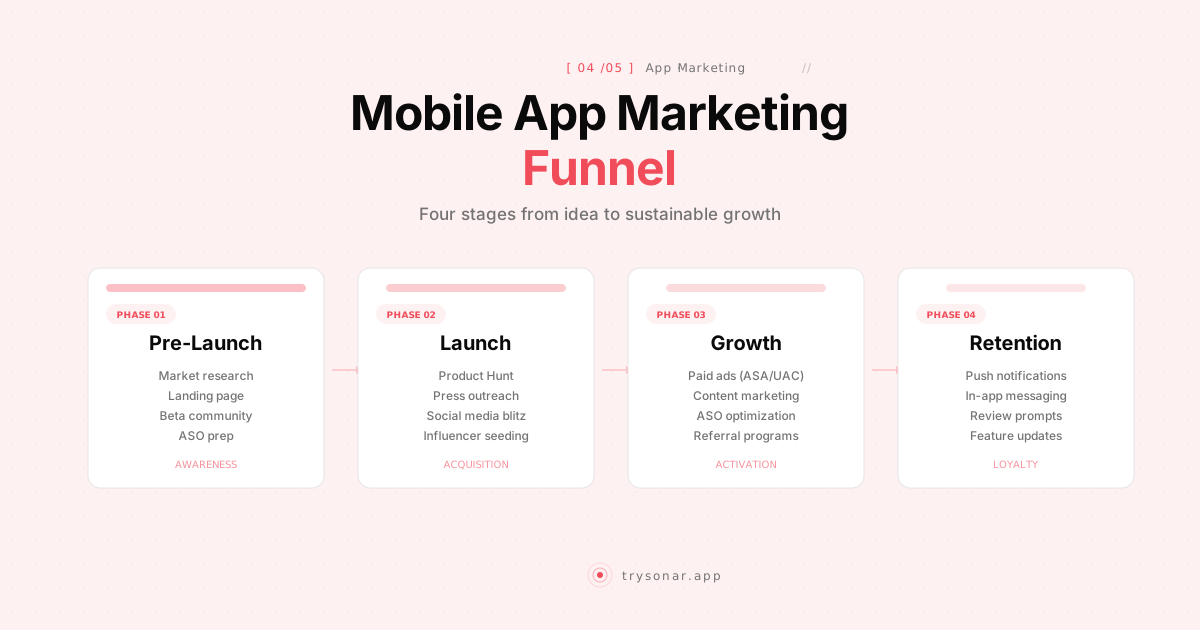
Phase 1: Pre-Launch (4-8 Weeks Before Release)
Most developers skip this entirely and wonder why launch day is quiet. Pre-launch work is what separates a launch that generates momentum from one that generates crickets.
Keyword Research and Metadata Optimization
Before you write a single marketing email, you need to know what people search for when they want an app like yours. This is keyword research, and it's the highest-leverage work you'll do.
What to do:
- Map your app to search terms. Open the App Store and Google Play, type words related to your app, and record every autocomplete suggestion. If you built a meditation timer, search "meditation," "mindfulness," "calm," "breathing," "sleep sounds" — note what comes up.
- Evaluate each keyword. You need two data points: how many people search for it (popularity) and how hard it is to rank (difficulty). High popularity + low difficulty = opportunity. Check sleep tracker keyword difficulty or running app keyword difficulty to see real examples. A tool like Sonar gives you both numbers instantly, or estimate manually by counting top-10 apps with the keyword in their title.
- Write your metadata for search, not ego. Your app title should contain your strongest keyword. Your subtitle (iOS) or short description (Google Play) should contain your second and third. Your keyword field (iOS) or full description (Google Play) covers the rest.
Budget: $0. Keyword research is free. A keyword tool saves time but isn't required.
Expected return: Apps with optimized metadata get 3-5x more organic search impressions than unoptimized apps. For most indie apps, organic search will be 50-70% of total installs — forever.
Build a Landing Page
You need a web presence before launch. Not a complex website — a single page with your app name, a screenshot or two, a one-sentence description, and an email signup form.
Why it matters:
- Collects early interest (email list for launch day)
- Gives you a URL to share on social media and forums
- Starts building domain authority for SEO
- Required if you want to pitch press
What to use: A free tier on Carrd ($0), a simple Next.js page on Vercel ($0), or a Notion page (functional but ugly). Don't spend more than a day on this.
Budget: $0-19/year for a domain. Hosting is free.
Build in Public
The biggest mistake indie developers make is building in silence. You should be posting about your app weeks before launch, not because you have a huge following, but because it compounds. Marc Lou built a portfolio of indie SaaS products to over $40K/month in revenue largely by documenting his process publicly on X, building an audience that converted into customers at each launch.
Where to post:
- X/Twitter: Share development progress, design decisions, interesting problems you solved. Use #indiedev, #iosdev, #buildinpublic. Post 2-3 times per week.
- Reddit: Find the subreddits where your target users hang out. Contribute genuinely first — when launch day comes, you'll have posting history and karma.
- Indie Hacker communities: Indie Hackers, Hacker News (Show HN), Product Hunt discussions. These audiences actively root for solo developers.
Budget: $0. This costs time, not money.
Phase 2: Launch Week
Your launch gets one window of momentum. Most platforms give new apps a slight ranking boost, and your personal network's attention is a finite resource. Use launch week strategically.
App Store Launch Optimization
On launch day, your store listing does the heavy lifting. Every visitor — whether from search, social media, or a press article — lands on this page. If it doesn't convert, nothing else matters.
The conversion checklist:
- Icon: Clean, simple, recognizable at 30x30px. No text, no photos, no gradients that looked cool in 2019.
- Screenshots: Show the app doing the thing people want. First screenshot = primary value prop. Don't waste it on a splash screen or onboarding flow. Add brief captions. Localize if targeting non-English markets.
- Title + subtitle: Keyword-optimized (you did this in Phase 1).
- Description: First three lines are visible without tapping "more" — make them count. Lead with the benefit, not the feature list.
- Rating prompt: Ship with a StoreKit rating prompt (iOS) or in-app review API (Android) triggered after a positive moment (task completed, streak reached, content saved). Don't prompt on first launch.
Product Hunt
Product Hunt is the single best free launch platform for indie apps. A successful launch (top 5 of the day) can drive 2,000-10,000 website visits and 500-2,000 direct installs.
How to do it well:
- Get a hunter. Someone with followers hunting your product increases visibility. Reach out 2 weeks before, or self-hunt.
- Launch at midnight PT. The 24-hour ranking window starts at midnight Pacific. Launch early to use the full window.
- Prepare your page. Gallery images (not just screenshots), a clear tagline, a maker comment explaining why you built it.
- Rally your network. Email your waitlist, post on social media. The first 2 hours matter most.
- Respond to every comment. Engagement signals quality and builds genuine connections.
Budget: $0.
Expected return: Variable. A top-5 finish brings real traffic. Finishing outside the top 20 brings very little. But even a modest showing gives you a "Featured on Product Hunt" badge and social proof.
Press and Blog Outreach
Cold-pitching TechCrunch won't work. But niche blogs, YouTube reviewers, and newsletter writers in your app's category are reachable and effective.
How to find them: Search "[your category] app review" on YouTube and contact creators with 5,000-50,000 subscribers. Search "[your category] apps" on Google and pitch the bloggers who rank. Look for niche newsletters on Substack and Beehiiv.
The pitch: Keep it to 5 sentences. What the app does, why it's different, why their audience would care, and an offer of promo codes. Attach 2-3 screenshots.
Budget: $0 for outreach. $50-150 per newsletter sponsorship placement (5,000-20,000 subscriber lists), which can drive 100-500 installs each.
Expected return: One good YouTube video or blog review can drive installs for months — people search "[category] best app" continuously.
Leverage Your Network
This is awkward but effective. On launch day, personally message 20-50 people you know. Not a mass blast — individual messages. "I launched my app today, would mean a lot if you checked it out and left a review if you like it."
Early reviews and ratings are critical. An app with 0 reviews converts at roughly half the rate of an app with 10+ reviews. Your first 20 reviews come from people you know. That's not gaming the system — it's how every successful app starts.
Budget: $0. Costs social capital, which replenishes.
Phase 3: Sustained Growth (Post-Launch)
Launch week traffic fades. The channels that matter long-term are the ones that compound: organic search (ASO), content marketing, and community.
ASO as an Ongoing Practice
ASO is not a one-time setup. The app stores are competitive and dynamic — new apps launch, competitors update their metadata, search trends shift seasonally.
Monthly ASO routine (30 minutes):
- Check your rankings. Are you moving up or down for your target keywords? If down, investigate — did a competitor update? Did a new app enter the space?
- Review search term performance. On iOS, App Store Connect shows you which search terms drive impressions and installs. On Google Play, the Acquisition reports show similar data. Double down on what's working.
- Test new keywords. Swap low-performing keywords in your iOS keyword field or Google Play description. Give each test 2-4 weeks before evaluating.
- Monitor competitors. When a competitor updates their metadata, look at what changed. They might have found a keyword you're missing.
Rank tracking tools automate this. Set up alerts for your top 10 keywords so you know immediately when rankings shift, rather than discovering a drop weeks later.
Budget: $0-29/month for a rank tracking tool. Manual tracking is free but time-consuming.
Content Marketing and SEO
Your landing page can become a traffic engine if you publish content your target users search for. This is the long game — it takes 2-6 months to see results, but the traffic is free and compounds indefinitely.
What to write about:
- "How to" guides related to your app's domain. Built a budget app? Write "How to Create a Monthly Budget." Built a habit tracker? Write "How to Build a Morning Routine."
- Comparison posts. "Todoist vs Things 3 vs [Your App]" — these rank for high-intent searches.
- Listicles. "7 Best Meditation Apps for Beginners" — include your app alongside established competitors. These posts rank well and drive targeted traffic.
Deciding which posts to write — and in what order — is where most of the leverage is. A tool like Boomranq turns your site into a prioritized, keyword-driven publishing calendar, so you spend those scarce writing hours on the topics most likely to rank instead of guessing.
Where to publish: Your own blog (best for SEO), Medium (built-in audience, you don't own the traffic), or guest posts on relevant blogs (backlinks help domain authority).
Budget: $0. Roughly 3-5 hours per article. Publish 2-4 per month for 6 months and you'll have a meaningful organic traffic stream.
Expected return: A well-optimized blog post targeting a 1,000+ monthly search volume keyword can drive 100-500 visitors per month indefinitely. At a 5-10% conversion rate to app install, that's 5-50 installs per month per article. The team behind Dripfeed, a vocabulary app, attributed over 30% of their installs to organic blog traffic from language-learning guides — content they wrote themselves over 6 months.
Social Media (Ongoing)
Don't try to be everywhere. Pick one platform where your target users actually spend time and go deep.
Platform selection:
- X/Twitter: Best for dev tools, productivity apps, B2B. The indie dev community is active and supportive.
- TikTok: Best for consumer apps, especially lifestyle, fitness, creativity. Short demo videos can go viral. Flighty, a solo-dev flight tracker, generated thousands of installs from organic TikTok content showing its live activity features — zero ad spend.
- Instagram: Good for visual apps — photo editing, design, lifestyle. Less effective for utility apps.
- YouTube: Long-form demos, tutorials, comparisons. Slow to build but content is evergreen. Widgetsmith hit #1 overall on the App Store largely through YouTube and TikTok creators discovering and reviewing it organically.
- Reddit: Best for niche apps. Find your subreddit, become a genuine community member, occasionally mention your app when relevant. r/productivity, r/fitness, r/cooking — wherever your users are.
The posting strategy that works:
- 80% value (tips, insights, behind-the-scenes, replies to others)
- 20% promotion (app updates, new features, user stories)
- Consistency matters more than volume. 3 posts per week beats 20 posts one week and silence the next.
Budget: $0.
Expected return: Social media rarely drives massive install numbers directly, but it builds brand awareness, creates a feedback loop with users, and gives you social proof for press pitches and store listing screenshots ("As seen on...").
Paid Acquisition (When Organic Is Working)
Don't spend money on ads until organic channels are working. If your store listing doesn't convert organic traffic, it won't convert paid traffic either. Paid ads amplify — they don't fix fundamentals.
When you're ready, start here:
Apple Search Ads (iOS):
The highest-ROI paid channel for most indie apps. You're bidding on keywords in the App Store — these users have the highest intent possible (they're literally searching for an app).
- Start with a $5-10/day budget
- Bid on your own brand name (cheap, defensive)
- Bid on competitor names (more expensive, but effective)
- Bid on category keywords that you already rank for organically (the paid + organic combination increases total installs)
- Expected CPI (cost per install): $0.50-3.00 for most categories. Niche utility apps are on the low end; competitive categories like fitness or finance are higher.
Google Ads (Universal App Campaigns):
Google automates placement across Search, Play Store, YouTube, and Display Network. Less control but broader reach. Budget $10-20/day, set a target CPI and let Google optimize. Expected CPI: $0.30-2.00, varies by category and country.
When to scale: If your CPI is lower than the lifetime value of a user, spend more. A subscription app charging $5/month with 20% month-1 retention has a 12-month LTV of roughly $12. Any CPI well under that is profitable.
Budget: $150-500/month when starting. Don't go higher until you've validated CPI and have LTV data.
Community Building
The most underrated growth channel. A small, engaged community creates a flywheel: users give feedback, you ship improvements, they tell friends, new users join.
Where to build it:
- Discord: Best for apps with power users who want to discuss features and share tips. Works well for productivity, creative, and gaming apps.
- In-app feedback: A simple "Send Feedback" button starts conversations that become testimonials and case studies.
- Public changelogs: Publish release notes publicly. Carrot Weather and Halide built devoted followings partly through personality-driven changelogs that made users feel like insiders.
Budget: $0.
Expected return: A user who's in your Discord and has talked to the developer is dramatically less likely to switch to a competitor. Community-driven apps consistently show higher retention and lower churn.
Get Featured by Apple or Google
Both app stores editorially curate featured apps. Getting featured can drive tens of thousands of installs in a single week, and it's disproportionately available to indie developers — Apple and Google actively look for well-crafted apps from small teams.
How to increase your chances:
- Use the latest platform features (widgets, Live Activities, Dynamic Island on iOS; Material You, app shortcuts on Android)
- Submit a story through Apple's App Store promotion page or Google Play's equivalent form
- Time submissions around seasonal events, platform launches, or cultural moments
- Have a polished, accessible, well-designed app — editorial teams care about craft
Overcast, the podcast app by Marco Arment, has been featured multiple times by Apple, each time generating significant download spikes with zero marketing spend.
Budget: $0.
Cross-Promotion (If You Have Multiple Apps)
If you maintain a portfolio of apps, cross-promotion is free and highly effective. A user who already trusts one of your apps is 5-10x more likely to download another.
Tactics:
- Add a "More Apps" section in your app's settings
- Use a small banner or bottom sheet to announce new launches
- Share the same developer page URL — users browsing one app will see your others
- On Google Play, create a developer collection
Sindre Sorhus maintains dozens of iOS utilities and consistently ranks across multiple App Store categories. Each new app benefits from his existing install base and developer page visibility. Tapbots (Ivory, Pastebot) follows the same strategy — loyal users of one app become day-one adopters of the next.
Budget: $0.
The Marketing Stack for a $0-500 Budget
Here's what a realistic indie developer marketing operation looks like, organized by priority:
Free (do all of these):
- ASO keyword research and metadata optimization
- Landing page with email signup
- Product Hunt launch
- Social media (pick one platform)
- Press outreach to niche blogs and YouTubers
- Community building (Discord or in-app)
- Content marketing (2-4 blog posts per month)
- Cross-promotion (if multiple apps)
$0-50/month:
- Apple Search Ads at $5-10/day for your highest-intent keywords
- Rank tracking tool to monitor keyword positions and competitor changes
$50-500/month:
- Increased Apple Search Ads budget ($10-20/day)
- 1-2 newsletter sponsorships per month in niche communities
- Google UAC at $10/day (if Android)
Measuring What Works
The metric that matters most is cost per install (CPI) by channel. Set up tracking from day one:
- App Store Connect / Google Play Console: Impressions, page views, installs, conversion rate by source. Check weekly.
- Paid attribution: Apple's SKAdNetwork or Google's install referrer to connect spend to installs.
- Web analytics: Track which blog posts and pages drive App Store clicks.
- Keyword rankings: Track your position for your top 10-20 keywords. A tool like Sonar automates this with alerts when rankings shift.
Organic search CPI is $0. Content marketing CPI is near $0. If Apple Search Ads costs $2.50 per install and your app makes $0.50 per user, that channel isn't working — improve monetization or reallocate.
Common Mistakes
Launching without ASO. You get one shot at launch momentum. If your metadata isn't optimized, you're wasting the algorithmic boost new apps receive. Use our ASO checklist to make sure nothing is missed.
Spending on ads before organic works. If your store listing converts at 10% from organic traffic, ads won't magically fix that. Get your conversion rate above 25-30% before spending money to drive traffic.
Trying every channel at once. You're one person. Pick 2-3 channels, execute well, and add more only when the first ones are working. ASO + one social platform + content marketing is enough for most indie apps.
Ignoring retention. An app with 40% day-1 retention will outgrow one with 15% day-1 retention every time, regardless of marketing spend. Fix onboarding before scaling acquisition.
Giving up after one month. App marketing compounds. Blog posts take 3 months to rank. ASO changes take 1-2 update cycles. The developers who succeed keep going past the silent period.
The Playbook, Summarized
- Pre-launch: Research keywords, optimize metadata, build a landing page, start posting on social media.
- Launch week: Ship with optimized listing, launch on Product Hunt, pitch niche press, ask your network for reviews.
- Post-launch: Maintain ASO monthly, publish content, stay active on one social platform, start small with Apple Search Ads when ready.
- Foundation: ASO is not one channel among many. It's the foundation. Every other channel drives traffic to your store listing — ASO determines whether that traffic converts.
The best mobile app marketing strategy for someone figuring out how to promote an app isn't the one with the biggest budget. It's the one with the best fundamentals, executed consistently. Start with your store listing. Everything else builds on that.