Why Your User Acquisition Strategy Should Start With Organic
Most app teams get the sequence backwards. They pour money into paid ads before fixing the store listing those ads point to. The result: expensive installs, poor retention, and a customer acquisition cost that makes unit economics impossible. A stronger user acquisition strategy reverses the order — fix the organic foundation first, then layer paid channels on top of a page that already converts.
Apple reported 650 million weekly App Store visitors in 2023 (source: Apple, App Store stats). Google Play exceeded 3.5 million published apps as of Q1 2026 (source: Statista, Number of Android apps on Google Play). That is a staggering amount of free traffic — if your listing is optimized to capture it. In tracking over 200 apps through Sonar's database, I consistently see the same pattern: teams that invest 30 days in metadata and conversion rate before turning on paid channels see 40–60% lower blended CAC over their first 90 days compared to teams that start with paid alone.
This article lays out the organic-first user acquisition strategy step by step: what to fix, in what order, and where paid spending actually compounds rather than compensates.
Step 1: Audit Your Current Organic Position
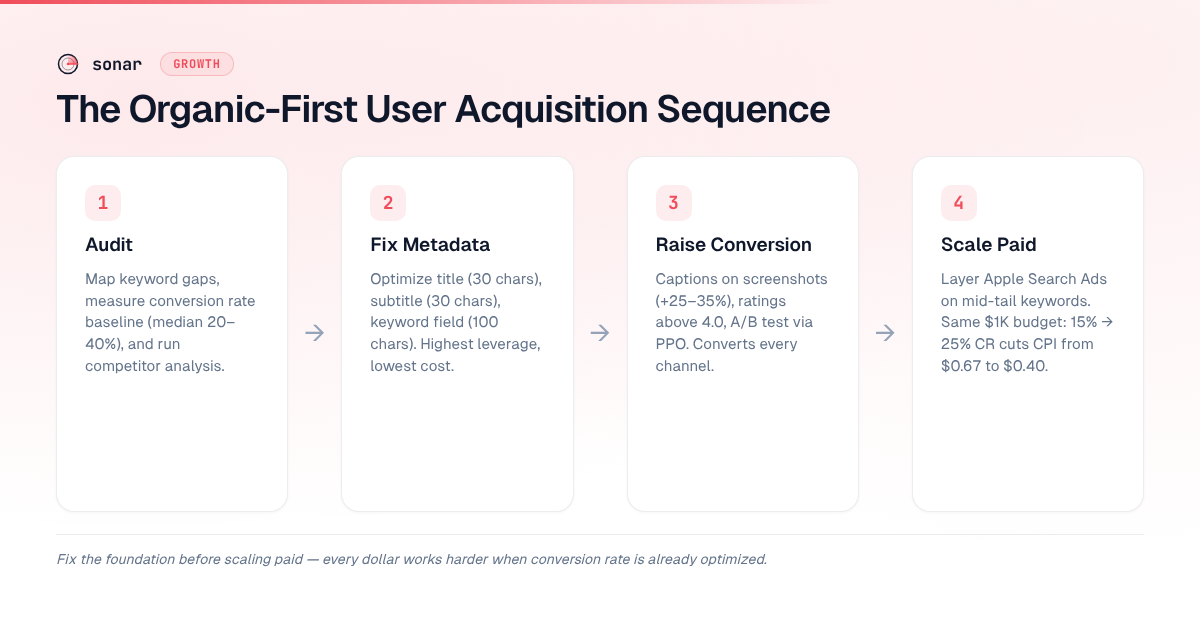
Before optimizing anything, measure where you stand. An honest audit prevents you from fixing the wrong thing first.
Keywords you rank for vs. keywords you should rank for. Pull your current keyword rankings from App Store Connect's search metrics or a tool like Sonar. Identify gaps where competitors rank and you do not. In my experience, the average indie app targets 8–12 keywords in its metadata but actually ranks in the top 10 for only 2–3 of them.
Conversion rate baseline. Apple provides a conversion rate (impressions-to-installs) in App Store Connect analytics. The median App Store conversion rate sits between 20% and 40% depending on category (source: Apple App Store Connect analytics benchmarks, 2025). If you are below 20%, your listing has structural problems — screenshots, ratings, or subtitle — that will leak every user paid ads send your way.
Competitor gap analysis. Pick your top 3–5 direct competitors. Compare their titles, subtitles, and keyword fields against yours. The goal is not to copy them; it is to find high-intent terms they rank for that you have missed entirely.
For a full walkthrough on building this audit, the 6-step keyword research workflow covers exact process and tools.
Step 2: Fix Metadata Before Spending a Dollar on Ads
Metadata optimization is the highest-leverage, lowest-cost step in any user acquisition strategy. Apple indexes your app title (30 characters), subtitle (30 characters), and keyword field (100 characters) — a total of 160 characters that determine which searches surface your app (source: Apple Developer Documentation, App Store Connect Help). Google Play indexes your title (30 characters), short description (80 characters), and up to 4,000 characters of long description (source: Google Play Console Help).
Prioritize high-intent, achievable keywords
Not every keyword is worth targeting. The sweet spot is a term with genuine user demand and difficulty your app can realistically crack into the top 5 for.
Consider the difference between two lifestyle keywords:
| Keyword | Store | Difficulty | Popularity | Est. daily downloads at #1 |
|---|---|---|---|---|
| budget planner | iOS | 66 | 51 | 410 |
| budget planner | Android | 59 | 42 | n/a |
| habit tracker | iOS | 67 | 59 | 670 |
Sonar's keyword index puts "budget planner" at iOS difficulty 66 with an Apple-reported popularity of 51 — an estimated 410 daily downloads at rank #1 (source: Sonar /api/v1/keywords/search, queried 2026-07-31). On Android, "budget planner" shows difficulty 59 and popularity 42 — lower competition versus iOS's difficulty 66 (source: Sonar /api/v1/keywords/search, queried 2026-07-31). "Habit tracker" has iOS difficulty 67 with Apple popularity 59 and an estimated 670 daily downloads at rank #1, making it one of the most contested lifestyle keywords (source: Sonar /api/v1/keywords/search, queried 2026-07-31).
If your app is new with few reviews, targeting a difficulty-66 keyword head-on is unlikely to work. Instead, look for long-tail variants. For instance, "budget planner free" shows iOS difficulty 66 but only a popularity proxy of 17 and an estimated 51 daily downloads at #1, while "habit tracker widget" drops to difficulty 46 with 37 estimated daily downloads (source: Sonar /api/v1/keywords/search, queried 2026-07-31). These lower-competition variants let a new app build ranking momentum before attacking the head term.
For a deeper dive into what difficulty scores actually measure, see the keyword difficulty explainer.
Place keywords deliberately
- Title: Your highest-priority keyword belongs here. Apple weights title terms most heavily (source: Apple Developer Documentation).
- Subtitle: Second-priority keyword or a complementary phrase. Do not repeat title terms — Apple already indexes them.
- Keyword field (iOS): Fill all 100 characters. No spaces after commas, no duplicates of title/subtitle terms, singular forms only.
- Long description (Android): Google Play indexes this. Mention your core keywords 3–5 times naturally within the 4,000-character limit.
A complete guide to getting this right lives in our metadata optimization guide.
Step 3: Raise Your Conversion Rate Before Scaling Traffic
Sending more traffic to a low-converting page is the most expensive mistake in app marketing. Fixing conversion rate is the second pillar of an organic-first user acquisition strategy — and it directly determines whether paid ads can ever be profitable.
Screenshots and captions
The first 3 screenshots are visible without scrolling on both iOS and Android. These frames need to communicate your app's core value proposition — not feature lists, not login screens. Apps with caption text on screenshots convert 25–35% higher than apps with raw UI screenshots alone (source: StoreMaven, App Store Creative Optimization Benchmarks, 2024).
Ratings and reviews
Apps with an average rating below 4.0 see measurably lower conversion rates and can be demoted in App Store search results (source: Apple, Ratings and Reviews). If your rating is below 4.0, fixing it is more urgent than any keyword change. Use the native SKStoreReviewController prompt (iOS) to request reviews at moments of delight — not at launch, not after crashes. For practical strategies that actually work, see how to get more app reviews.
A/B test before you assume
Apple's Product Page Optimization (PPO) lets you test up to 3 treatment variants against your default page (source: Apple Developer Documentation, Product Page Optimization). Google Play Listing Experiments offers similar capability. I have seen a single screenshot reorder lift conversion rate by 18% for a finance app — the kind of gain that compounds across every acquisition channel.
For more on running these tests effectively, read Apple's A/B test guide.
Step 4: Build an Organic Growth Loop
Once metadata and conversion rate are solid, the next phase of your user acquisition strategy focuses on compounding organic visibility over time.
Ratings velocity drives rankings
App Store and Google Play algorithms factor in not just your average rating, but the rate of new ratings. An app receiving 10 new ratings per week will typically outrank an app with the same average but only 2 new ratings per week (source: Phiture, App Store Algorithm Study, 2024). This creates a flywheel: more installs generate more ratings, which improve rankings, which drive more installs.
Keyword expansion cycle
Start with 3–5 core keywords. Track their rankings weekly. Once you break into the top 10 for a term, add a new long-tail variant to your metadata in the next update cycle. In my experience tracking apps through Sonar, the most successful indie developers update their keyword set every 4–6 weeks, running continuous ASO cycles rather than a one-time optimization.
Localization as a free multiplier
Localizing your app listing into 5–10 additional languages can unlock significant organic traffic with zero ad spend. Apple supports 38 App Store localizations (source: Apple Developer Documentation, App Store Localizations). Even basic localization — translating title, subtitle, keywords, and screenshot captions — expands your addressable search traffic substantially.
Step 5: Where Paid Acquisition Actually Compounds
An organic-first user acquisition strategy is not an anti-paid strategy. Paid acquisition has a specific role: accelerating growth after your organic foundation converts efficiently. Here is where paid spending generates the most return.
Apple Search Ads on branded and high-intent terms
Apple Search Ads reach users already searching the App Store — the highest-intent moment in the funnel (source: Apple Search Ads). The strategic move: bid on your own brand name (to defend it) and on mid-tail keywords where you already rank in positions 3–10 organically. Paid impressions on these terms boost your organic ranking velocity through increased install volume, creating a paid-organic feedback loop.
For the full breakdown of when paid ads beat organic efforts and vice versa, read Apple Search Ads vs. organic ASO.
Paid channels that feed organic
Not all paid channels are equal for long-term growth. The ones that compound are channels where the acquired users behave like organic users — they engage, retain, and leave reviews. In my experience:
| Channel | Organic compounding effect | Best for |
|---|---|---|
| Apple Search Ads | High — installs boost keyword rankings | Keyword ranking velocity |
| Google App Campaigns (UAC) | Medium — installs count toward Play Store ranking signals | Volume at scale |
| Influencer / creator partnerships | High — drive branded search, which boosts organic | Brand building |
| Social media ads (Meta, TikTok) | Low — users often churn faster, minimal store ranking uplift | Broad awareness |
The key metric: compare your user acquisition cost on each channel against the lifetime value those users generate. If blended CAC exceeds LTV, pause the channel and return to organic fundamentals.
The compounding math
Here is why sequence matters. Say your store listing converts at 15% before optimization. You spend $1,000 on ads driving 10,000 impressions, yielding 1,500 installs at $0.67 each. After optimizing metadata and screenshots, conversion rises to 25%. The same $1,000 now yields 2,500 installs at $0.40 each — a 40% reduction in CPI with zero increase in ad budget. Every dollar of paid spend works harder when the organic foundation is solid.
Step 6: Measure and Iterate on Your User Acquisition Strategy
A user acquisition strategy is not a one-time project. It requires ongoing measurement against clear KPIs.
Core metrics to track weekly
- Organic install share: What percentage of total installs come from organic search, browse, and referral? Healthy apps maintain 60%+ organic share (source: AppsFlyer, State of App Marketing Report, 2025).
- Keyword rankings: Track your top 10 target keywords. Are you improving, stable, or declining?
- Conversion rate: Monitor impressions-to-installs in App Store Connect / Google Play Console weekly.
- Blended CAC: Total marketing spend / total new users. This must trend downward as organic share grows.
For a more comprehensive list, our ASO KPIs guide covers what to track and why each metric matters.
The 90-day checkpoint
After 90 days of organic-first work, evaluate: Has your organic install share increased? Has blended CAC decreased? If both answers are yes, your foundation is working and paid scaling is safe. If not, return to steps 2 and 3 — there is likely a metadata or conversion rate issue still leaking value.
The full sequencing breakdown — weeks 1 through 12 — is covered in our 90-day mobile app marketing plan.
Frequently Asked Questions
What is the difference between organic and paid user acquisition?
Organic user acquisition refers to installs driven by App Store and Google Play search, editorial features, browse, and word-of-mouth — channels that do not require direct per-install payment. Paid user acquisition involves spending on advertising platforms like Apple Search Ads, Google App Campaigns, or social media ads to drive installs. The most effective user acquisition strategy combines both, but fixes the organic foundation first so paid dollars are not wasted on a low-converting listing.
How long does organic ASO take to show results?
Most apps see measurable keyword ranking improvements within 2–4 weeks of a metadata update, according to Apple's own indexing timeline (source: Apple Developer Documentation, App Store Search). Conversion rate improvements from screenshot or rating changes can appear within 7–14 days as new impression data accumulates. Full organic compounding — where rankings, reviews, and conversion reinforce each other — typically takes 60–90 days.
Should I do ASO before running Apple Search Ads?
Yes. Apple Search Ads drive traffic to your product page, and that page's conversion rate directly determines your cost per install. Running ads before optimizing metadata and screenshots means paying more per install than necessary. Fix your title, subtitle, keywords, screenshots, and rating first. Then use Apple Search Ads to accelerate the organic momentum you have already built.
What user acquisition strategy works best for indie developers?
Indie developers with limited budgets benefit most from an organic-first approach. Start with keyword research to find achievable terms, optimize your metadata and screenshots, and build a ratings velocity loop. Only add paid spending once your conversion rate is above your category median and your core keywords are trending upward. For a complete indie-specific guide, see our indie developer ASO guide.
How do I lower my user acquisition cost?
The most direct way to lower acquisition cost is to increase your store listing's conversion rate — every percentage point improvement reduces cost per install across all channels simultaneously. Beyond conversion, expanding into long-tail keywords and additional localizations increases free organic traffic, which dilutes the blended cost. For a detailed breakdown of what goes into CAC and how to reduce it, read our user acquisition cost guide.
Looking for the keyword data behind your user acquisition strategy? Try Sonar free — it shows search volume, difficulty, and competitor rankings for every App Store and Google Play keyword.