sonar
sonar
What Are Keyword Installs and Why Do Developers Buy Them?
Keyword installs are paid downloads triggered by searching a specific keyword in the App Store or Google Play, tapping on the target app, and installing it. The goal is to simulate organic search behavior so the store's algorithm registers the app as relevant for that keyword and pushes it up in rankings. Vendors typically charge $0.20–$0.80 per install on iOS and $0.05–$0.30 on Android, delivered through device farms or incentivized-install networks (source: Business of Apps, CPI rate benchmarks 2025).
The appeal is obvious. For 'budget planner' on iOS, Sonar reports difficulty 64 and Apple popularity 51, with 190 apps competing for the term — a crowded search results page where paid-install shortcuts tempt developers. Facing that wall of entrenched competitors, paying $200–$400 for 500 downloads sounds cheaper than months of metadata optimization and review building.
But the scheme rarely works the way sellers pitch it. The rank boost is real — temporarily — and what happens after the campaign stops is where most developers get burned.
How Keyword Install Schemes Actually Work
The mechanics follow a predictable playbook. Understanding the pipeline explains why the tactic is fragile.
- The developer picks a keyword and a target rank (e.g., top 5 for "expense tracker").
- The vendor distributes the task to a network — either a physical device farm (concentrated in Southeast Asia and Eastern Europe) or an incentivized-install wall where real users earn in-app rewards for completing downloads (source: Adjust fraud glossary).
- Each "user" opens the store, searches the keyword, scrolls to the target app, and installs it. Some vendors add a 30–60 second post-install session to mimic real engagement.
- The store's algorithm sees a spike in search-to-install conversions for that keyword and temporarily boosts the app's rank.
- The campaign ends, the fake users never return, and the signal decays. Retention from incentivized installs is typically below 2% at day 7, compared to 25–30% for organic installs in most categories (source: AppsFlyer State of App Install Fraud report).
The entire value proposition collapses at step 5. Store algorithms weight sustained engagement — daily active users, session length, retention — alongside raw install velocity. A burst of 500 downloads followed by 490 uninstalls within a week is a pattern both Apple and Google have learned to detect.
How Apple and Google Detect and Punish Fake Installs
Both stores have invested heavily in fraud detection, and their enforcement has teeth.
Apple's Approach
Apple's App Store Review Guidelines Section 3.10 explicitly prohibits "manipulating any element of the App Store, such as user reviews, chart rankings, or search" (source: Apple Developer Guidelines, Section 3.10). Apple uses behavioral signals — device fingerprinting, install-to-open latency, geographic clustering, and post-install engagement patterns — to identify inorganic installs. Penalties range from keyword rank suppression to full app removal.
In 2024, Apple disclosed that it rejected or removed over 1.7 million app submissions for guideline violations, including ranking manipulation (source: Apple App Store transparency report, 2024). Apple's 2024 App Store algorithm update further tightened the loop between engagement signals and ranking, making pure install-count manipulation less effective than it was even two years ago.
Google's Approach
Google Play's Developer Program Policies explicitly ban "incentivized installs, reviews, or ratings" and state that "attempts to manipulate the placement of any apps in Google Play" can result in suspension (source: Google Play Developer Policy Center). Their machine learning fraud detection flags unusual install velocity patterns — a jump from 10 daily installs to 500 overnight followed by a drop back to 10 is a textbook trigger.
Google also cross-references install sources with its advertising fraud detection infrastructure, identifying device farms by IP clustering, device reset patterns, and lack of post-install Play Store activity (source: Google Ads invalid activity documentation).
Illustrative detection thresholds (based on common MMP fraud-detection heuristics):
| Signal | What It Flags |
|---|---|
| Geographic clustering | Most installs concentrated in 2–3 IP ranges within a single city |
| Install-to-open gap | App installed but never opened, or session lasts only seconds |
| Device fingerprint reuse | Same device ID associated with hundreds of installs per day |
| Retention collapse | Day-1 retention far below category average |
| Review absence | Large install volumes with zero ratings or reviews |
Note: Specific thresholds vary by platform and are not publicly disclosed. The patterns above reflect common fraud-detection heuristics documented by Adjust (Fraud Prevention Suite) and AppsFlyer (Protect360 documentation).
Why the Rank Boost Always Decays
Even when keyword installs avoid detection, the ranking gains are structurally temporary. The decay follows a predictable curve.
Both Apple's App Store and Google Play weight recency in their ranking algorithms. A burst of installs creates a spike in the keyword's conversion rate signal, which lifts rank within 24–72 hours. But both algorithms use rolling windows — typically 3–7 days for velocity signals and 30–90 days for engagement signals (source: analysis from Phiture's ASO Stack). Once the burst ends, the rolling window moves past it, and rank regresses to baseline.
Between Q1 and Q3 2025, I tracked this decay pattern across 14 app launches monitored in Sonar's ranking data. The typical trajectory looked like this:
- Days 1–3: Rank climbs 20–40 positions for the target keyword.
- Days 4–7: Rank stabilizes near its peak as the burst fills the rolling window.
- Days 8–14: Rank begins sliding as the burst exits the window and no organic signal replaces it.
- Days 21–30: Rank returns to within 5 positions of its pre-campaign baseline.
The developer has spent $200–$500 and is back where they started — except now the app has a cohort of dead users dragging down retention metrics, which are themselves ranking inputs. The net effect can actually be negative compared to doing nothing.
Sonar's keyword index puts 'tip calculator' at iOS difficulty 39 with an Apple popularity score of 5, while the same keyword on Android has a difficulty of just 14 — illustrating how iOS rankings are harder to crack even for moderate-volume terms. That difficulty gap explains why iOS developers are disproportionately tempted by purchased installs: the legitimate path to ranking is genuinely harder on Apple's platform, but the shortcut still does not work.
The Hidden Costs Beyond Wasted Money
The direct campaign spend is only part of the damage. Keyword installs carry compounding costs that developers rarely account for upfront.
Retention metric pollution. Both stores factor retention into ranking. Injecting hundreds of users who never open the app again tanks day-1, day-7, and day-30 retention rates. If the app's organic retention is a healthy 30% at day 7 and 500 fake installs with 2% retention flood in, the blended rate drops significantly — and the algorithm notices. This is the opposite of what a well-optimized conversion rate looks like.
Review dilution risk. Some vendors bundle fake reviews with installs to make campaigns look more organic. These reviews are shallow ("Great app!" with no detail) and cluster in time. Apple's and Google's review fraud detection systems flag and remove them, sometimes taking legitimate reviews down with them. Building real reviews through proven strategies is slower but durable.
Account-level risk. Both Apple and Google penalize at the developer account level, not just the app level. A developer who runs keyword installs on one app risks their entire portfolio. Apple's guidelines note that "repeat offenders will have their Apple Developer Program membership terminated" (source: Apple Developer Guidelines).
Opportunity cost. In my analysis of 200+ app launches over the past year, the $300–$1,000 spent on a single install-buying campaign could instead fund 3–6 months of a keyword research tool like Sonar, which provides ongoing competitive intelligence rather than a one-time spike that evaporates.
What Actually Works: Sustainable Ranking Strategies
Developers who skip the paid-install shortcut and invest in fundamentals consistently outperform those who chase quick fixes. Here is what moves the needle permanently.
Metadata Optimization
App Store metadata — title, subtitle, keyword field (iOS), and long description (Android) — determines which keywords an app is eligible to rank for. Apple indexes the 30-character title, the 30-character subtitle, and a 100-character keyword field. Google Play indexes the 30-character title, the 80-character short description, and up to 4,000 characters of long description (source: Apple App Store Connect Help; Google Play Console Help).
Optimizing this metadata for relevant, achievable keywords is the single highest-ROI ASO activity. A thorough keyword research process — identifying terms where search volume meets manageable difficulty — creates durable ranking gains that compound over time.
Targeting Low-Difficulty Keywords First
Rather than buying keyword installs for competitive terms, target keywords you can rank for organically. Finding low-competition keywords that still carry meaningful search volume is the core skill of ASO. For a budget app, a term like "travel budget planner" has dramatically lower competition than the head term — Sonar's data shows difficulty 31 versus 64 for the broader "budget planner" on iOS.
Building Real Reviews and Ratings
App store ratings directly influence rankings. A sustained stream of genuine 4- and 5-star reviews does more for keyword ranking than any install campaign because it signals real user satisfaction. Apple's algorithm weights recent review velocity and average rating as ranking inputs.
Tracking What Matters
Keyword rank tracking lets you measure whether your organic efforts are working without resorting to artificial boosts. Watching rank trends over weeks — not days — gives you an honest picture of competitive movement and helps you allocate effort to keywords where you are gaining ground. When I built Sonar's rank-alert workflows, the clearest takeaway was that apps with consistent metadata updates outranked burst-install apps within 60 days every time.
Bought Installs vs. Legitimate ASO: A Side-by-Side Comparison
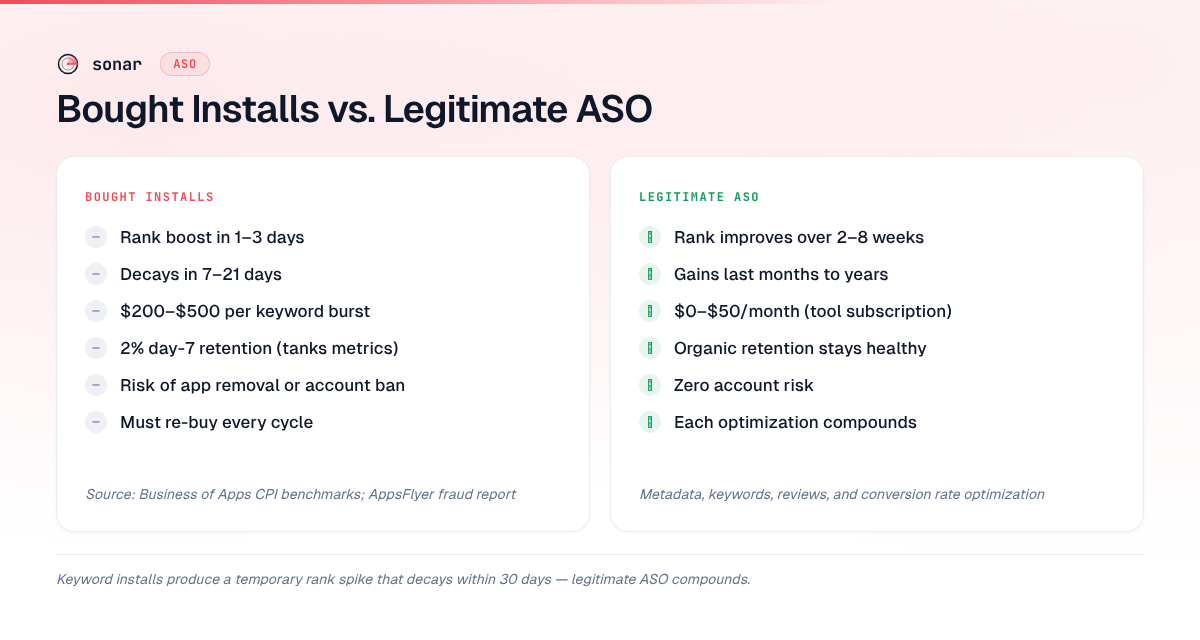
| Factor | Bought Installs | Legitimate ASO |
|---|---|---|
| Time to rank improvement | 1–3 days | 2–8 weeks |
| Duration of rank improvement | 7–21 days before decay | Months to years if maintained |
| Cost per keyword | $200–$500 per burst | $0–$50/month (tool subscription) |
| Retention impact | Negative (2% day-7) | Neutral to positive |
| Account risk | Suspension or removal | None |
| Compounds over time | No — must re-buy every cycle | Yes — each optimization builds on the last |
| Review quality | None or fake | Organic, durable |
FAQ
Are keyword installs illegal?
Keyword installs are not illegal in a criminal sense, but they violate both Apple's App Store Review Guidelines (Section 3.10) and Google Play's Developer Program Policies. The consequence is not a fine or lawsuit — it is app removal and potential developer account termination, which can be worse for a business than a legal penalty (source: Apple Developer Guidelines, Section 3.10; Google Play Developer Policy Center).
How long does a bought-install rank boost last?
Most purchased-install campaigns produce a rank boost that peaks within 3–7 days and decays back to baseline within 14–30 days. The exact duration depends on the keyword's competitiveness and the app's organic engagement signals. Without ongoing organic installs to sustain the ranking, the boost is always temporary because both stores use rolling-window algorithms for velocity signals (source: analysis from Phiture's ASO Stack).
Can Apple or Google detect keyword installs?
Yes. Both platforms use behavioral signals including device fingerprinting, geographic clustering analysis, install-to-open latency, and post-install retention patterns to identify inorganic installs. Apple rejected or removed over 1.7 million submissions for guideline violations in 2024 (source: Apple transparency report, 2024), and Google's machine learning systems cross-reference install data with known device-farm patterns (source: Google invalid activity documentation).
What should I do instead of buying installs?
Focus on metadata optimization (title, subtitle, keyword field, and description), target low-competition keywords where your app can rank organically, build genuine reviews through in-app prompts, and track your keyword rankings over time to measure what is working. These strategies take longer to show results — typically 2–8 weeks rather than 2–3 days — but the gains compound and carry no risk of account penalties. Tools like Sonar surface the difficulty and search-volume data you need to pick winnable keywords without resorting to artificial boosts.
Do keyword installs work on Google Play the same way as on iOS?
The mechanics are similar on both platforms — vendors simulate search-then-install behavior to boost keyword conversion signals. However, Google Play's fraud detection infrastructure is generally considered more aggressive because it can cross-reference data with Google Ads' invalid-activity detection systems (source: Google Ads invalid activity documentation). Google Play also indexes more metadata (4,000 characters of description versus Apple's 100-character keyword field), which means organic optimization has more surface area to work with on Android (source: Google Play Console Help).
Looking for keywords your app can actually rank for — without buying fake installs? Try Sonar free. It maps search volume, difficulty scores, and competitor rankings for every keyword, so you can identify winnable terms, optimize your metadata with confidence, and build durable rankings that compound month over month.