sonar
Across 34 iOS apps Sonar tracked from launch, the median best-keyword rank was flat for eight weeks: no spike in week one, no slide after it (Sonar data). Yet developers keep reporting the same pattern: a few good days after release, then downloads fall off a cliff. Both can be true at once, and the gap between them tells you what to do in your own launch window.
By Peter. Sonar rank history from March 1 to October 1, 2026; live keyword lookups October 23, 2026.
Does the App Store give new apps an actual new app boost?
Sonar's rank history shows no measurable new app boost in keyword rankings: for 34 iOS apps tracked from launch, the median change in their best five non-brand keyword ranks stayed between 0 and +3 places through week 8 (Sonar data). That is a statement about tracked keyword ranks, not about Apple's algorithm. Apple doesn't document a new app boost, and it doesn't document the absence of one either.
What this data can't see matters as much as what it can:
- Downloads, Browse and featuring aren't measured. A boost could live on the Today tab, in category lists or in "new" surfaces without touching keyword ranks.
- Tracking starts around day 5. The median app in the cohort got its first Sonar rank five days after release (Sonar data). A boost that ends within the first few days would be missed.
- iOS ranks in this window came from the iTunes Search API, which orders results mostly by text relevance. Sonar's August 2026 check against true App Store ranks found tail terms reading 20–40 places too optimistic (Sonar comparison against DataForSEO true App Store ranks, August 2026). A boost driven by early downloads would be largely invisible in a relevance-ordered list.
- Small, specific sample. 34 iOS apps, mostly indie apps whose owners track them in Sonar from launch.
So the honest reading is narrow: if a new app boost exists, it doesn't show up as a rise-then-fall in the keyword ranks we track.
Downloads dropped sharply after a 3-day launch spike
Indie developers in r/AppStoreOptimization describe a "honeymoon" of roughly three days to a week after launch. One reported 60–70 downloads a day at first, then a steep fall; another saw iOS downloads collapse after a three-day spike. They disagree on whether the effect shrank or disappeared in February–March 2026. Treat these as reports, not measurements: nobody in those threads separated search downloads from everything else.
Here's a hypothesis that fits both the reports and Sonar's data: the drop people feel after launch week is more likely traffic from outside search fading than keyword ranks falling. Launch week stacks one-off sources on top of search:
| Traffic source | Launch week | Week 3 |
|---|---|---|
| Launch posts (X, Reddit, Product Hunt, newsletters) | Peaks on the day you post | Mostly gone |
| Friends, beta testers, mailing list | Front-loaded | Gone |
| Pre-order conversions, if you ran one | Delivered on release day | Gone |
| Keyword search | Whatever your ranks earn | Roughly the same (Sonar data: median rank flat) |
When the one-offs fade, you're left with the search baseline, and for most new apps that baseline is small: new listings tend to win long-tail terms with little measurable demand (see how many downloads a new app should get). A spike that lands on a near-zero search floor looks exactly like a boost that "ended".
Sonar data: rank paths of newly launched apps
Sonar compared 34 new iOS apps (released March 1 to July 28, 2026, first Sonar rank within 14 days of release) with a control group of 72 established small apps (released before 2025, under 1,000 ratings). Each app's panel was its five best non-brand keywords in week 0, the first week it ranked for one (Sonar data). The control group matters: picking each app's best keywords guarantees some regression to the mean, and the control absorbs it.
Weekly: flat median, fatter tail of decliners
| Week | New apps (n) | New: median best-5 rank | New: median change vs week 0 | New: % slipping 10+ | Control (n) | Control: median change | Control: % slipping 10+ |
|---|---|---|---|---|---|---|---|
| 0 | 34 | 18 | 0 | 0% | 72 | 0 | 0% |
| 1 | 27 | 18 | +0.5 | 25.9% | 67 | 0 | 6.0% |
| 2 | 26 | 16.25 | 0 | 26.9% | 66 | 0 | 6.1% |
| 4 | 23 | 11.5 | 0 | 30.4% | 62 | 0 | 11.3% |
| 6 | 21 | 14.5 | 0 | 23.8% | 61 | +1 | 13.1% |
| 8 | 15 | 9.5 | +3 | 26.7% | 56 | +0.75 | 17.9% |
Positive change = worse rank. Source: Sonar data, iOS, ranks March–October 2026. The median-rank column drifts as apps drop out of tracking; the change column compares each app with its own week 0.
Two findings sit in this table:
- The typical app didn't move. Median change stayed between 0 and +3 places for new apps and 0 to +1 for the control (Sonar data). No week-one peak, no decay curve.
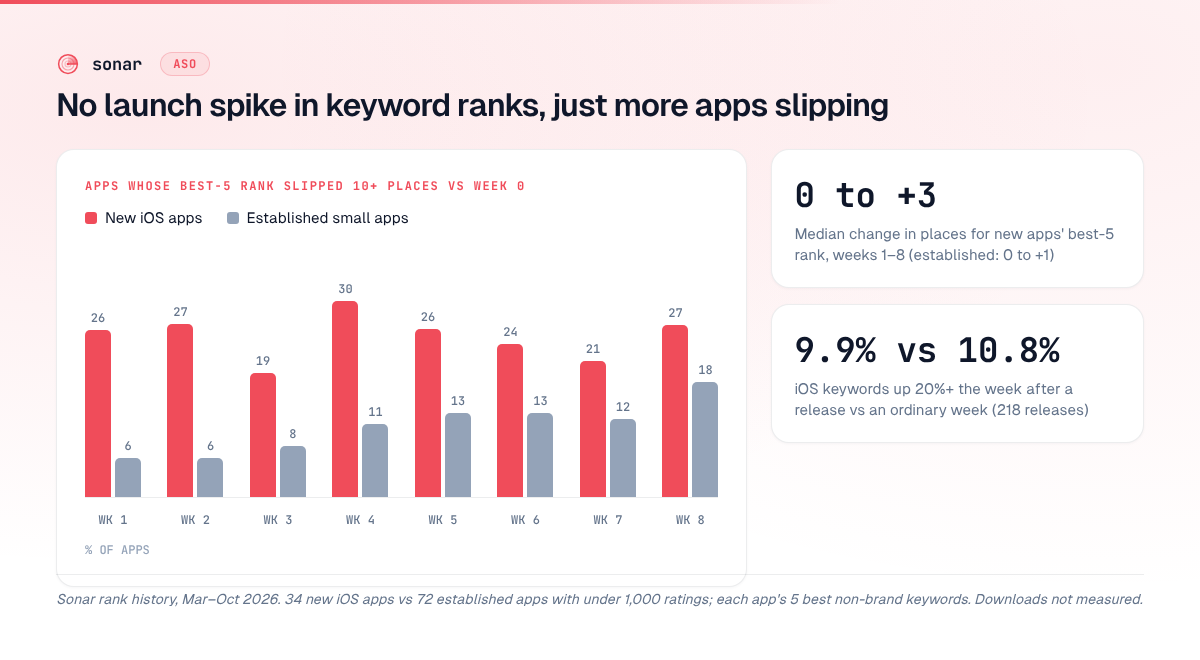
- The tail is real. Between 19% and 30% of new apps had their best-5 median slip 10+ places in weeks 1–8, against 6–18% of established small apps (Sonar data). New apps are more volatile, and about a quarter of them lose meaningful ground on their best terms.
That second finding is the closest thing in the data to the "fall-off" developers describe. It is spread across weeks, not concentrated after launch week, which looks more like a new listing finding its level than a timed boost expiring.
Daily: a small drift up, then back to start
For 21 iOS apps first ranked on day 0–2 after release, observed ranks drifted slightly better over the first two weeks and returned to their starting point by days 35–42 (Sonar data).
| Day after first rank | Median change vs first day | % of apps 10+ places worse |
|---|---|---|
| 0 | 0 | 0% |
| 4 | −5 | 0% |
| 7 | −4 | 6.7% |
| 14 | −5 | 7.7% |
| 21 | −2.25 | 6.2% |
| 28 | −2 | 0% |
| 35 | 0 | 0% |
| 42 | 0 | 7.7% |
Negative change = better rank. Source: Sonar data, iOS, observed ranks only, 8–18 apps per day.
Nothing here peaks in launch week and then declines. If anything, the median app gained a few places in weeks one and two.
Google Play: too few apps to say anything
Only 14 new Google Play apps met the same cohort rules, with 3–14 per week (Sonar data). That's too small to read a curve, so this post draws no Android conclusions from rank data.
When app updates are released, are there additional boosts of traffic from Apple?
In Sonar's data, keyword ranks in the week after an update were no better than in an ordinary week. Across 218 clean iOS release events, 9.9% of keywords improved by 20% or more in the week after release, versus 10.8% across an ordinary pre-release week with no release in it (Sonar data). The median event-level change was 0 in every comparison.
| Store | Events | Keywords improved 20%+ (week after release) | Improved 20%+ (ordinary week) | Worsened 25%+ (week after release) | Worsened 25%+ (ordinary week) |
|---|---|---|---|---|---|
| iOS | 218 | 9.9% | 10.8% | 13.6% | 10.2% |
| Google Play | 246 | 18.4% | 16.4% | 16.6% | 17.7% |
Source: Sonar data, release events detected May 1 to September 15, 2026, no other release within ±14 days; keywords ranked 2–100 before release.
The iOS "worsened" column is slightly higher after releases, but the difference is small and wasn't tested for significance. Don't read it as "updates hurt rankings". Read it as "an update by itself isn't a ranking lever". What an update can do is ship metadata changes: on iOS, the keyword field is part of each version's information in App Store Connect, so new keywords only go live with a new version (Apple App Store Connect Help). The ranking movement comes from what you change, not from the version bump. For what to put in the notes themselves, see release notes that do ASO work.
How to recover downloads after the launch spike
Yes, but not by waiting for a second new app boost. If launch traffic came from outside search, "back up there" means replacing that traffic, and the durable replacement is ranking for keywords with measurable demand. Start by separating two different problems:
- Your keyword ranks actually fell. Check your best terms day by day. If they slipped 10+ places, as about a quarter of new apps did (Sonar data), work through the ranking-drop diagnostic before changing anything.
- Your ranks held but downloads fell. That's the launch spike fading onto your search baseline. Fix the baseline: rank for terms people actually search.
The second case is the common one, and it's a keyword-choice problem. Compare two live examples from Sonar's API (US, Apple popularity, October 23, 2026):
| Keyword | Apple Search Popularity | Sonar difficulty | Read |
|---|---|---|---|
| habit tracker | 57 | 73 | Real demand, crowded top 10 |
| habit tracker with friends | 22 | 27 | Measurable demand, beatable top 10 |
| budget planner | 32 | 60 | Real demand, hard for a new app |
Source: Sonar API, /api/v1/keywords/metrics, iOS US, October 23, 2026.
A new app that targets only the 57-popularity head term will likely sit too deep to see traffic. A longer phrase with Apple-measured demand and a weak top 10 is where a new listing can actually land in the top results and hold there.
How to use the launch window
Whatever Apple does or doesn't boost, your launch window is the only time a lot of people open your app at once. Use it on things that compound.
Ship your final keywords at launch
Launch with the metadata you intend to keep. Every visitor in launch week sees and searches against the listing you shipped, and on iOS, changing the keyword field means submitting a new version (Apple App Store Connect Help). The full pre-launch sequence is in app launch strategy; if you're taking pre-orders, the iOS pre-order guide covers how release-day conversions land.
Don't churn metadata in the first weeks
Give your listing time to settle before you read anything into ranks. Sonar's daily data shows new-app ranks moving a few places in either direction over the first two weeks (Sonar data). Change the title or keywords on day 4 and you can't tell whether a later move came from your edit or from that settling. Pick a date three to four weeks out to make your first metadata decision.
Ask for ratings while traffic is high
Launch week is when most of your early users open the app, so it's when a rating prompt reaches the most people. On iOS, use StoreKit's requestReview (the successor to SKStoreReviewController); Apple limits the prompt to three displays per user in a 365-day period, and the system decides whether it actually appears (Apple Developer Documentation). With only three shots a year, trigger it after a success moment, not on first launch. How ratings feed rankings is covered in App Store ratings and rankings.
Read the post-launch baseline, not the spike
Measure your organic baseline from about week 3 onward, once the launch posts have stopped sending traffic. Compare it with what your keyword ranks should produce. How many downloads a new app should get walks through that calculation keyword by keyword. Sonar's rank tracker records your daily position for each term, so you can see whether a slow week came from ranks or from traffic outside search.
A note on Google Play
Google Play has no documented new app boost either. A new listing starts with no install, rating or retention history so a quiet first few weeks is normal; the details are in does Google Play give new apps any impressions?. Sonar's 14-app Play cohort is too small to add rank data to that.
Frequently asked questions
Is the new app boost on the App Store real?
Apple doesn't document one. In Sonar's rank history, 34 new iOS apps showed no rise-then-fall in their best keyword ranks over eight weeks, but downloads, Browse and featuring weren't measured, and tracking started around day 5. The data rules out a visible keyword-rank boost in the tracked window, not every possible form of new app boost.
How long does the new app honeymoon last?
Developers commonly report three days to a week of elevated downloads after launch. Sonar's data didn't find a matching window in keyword ranks, which is consistent with the honeymoon being mostly launch traffic from outside search: launch posts, friends, pre-orders. Sonar doesn't measure downloads, so treat that as a likely explanation, not a proven one.
Do app updates give another ranking boost?
Not in Sonar's data. Across 218 iOS release events, 9.9% of keywords improved 20%+ in the week after release versus 10.8% in an ordinary week, and the median change was 0. Updates matter when they ship metadata changes, not because a new version exists.
Why did my downloads drop after launch week if my ranks didn't?
One likely explanation: launch-week downloads come from more than search. When the one-off sources fade, you're left with what your keyword ranks earn, which for most new apps is small. Check your ranks first: if they held, the fix is better keyword targeting, not a relaunch.
Should I relaunch or re-release my app to get the boost back?
No evidence supports it. Sonar's release data shows no rank bump after updates, and nothing in the weekly cohort points to a resettable launch effect. Put the effort into keywords with measurable demand and a beatable top 10.
Want to see whether a post-launch drop came from your ranks or from fading launch traffic? Sonar tracks daily keyword ranks with Apple's search popularity side by side on the Indie and Agency plans. Start free trial.