sonar
sonar
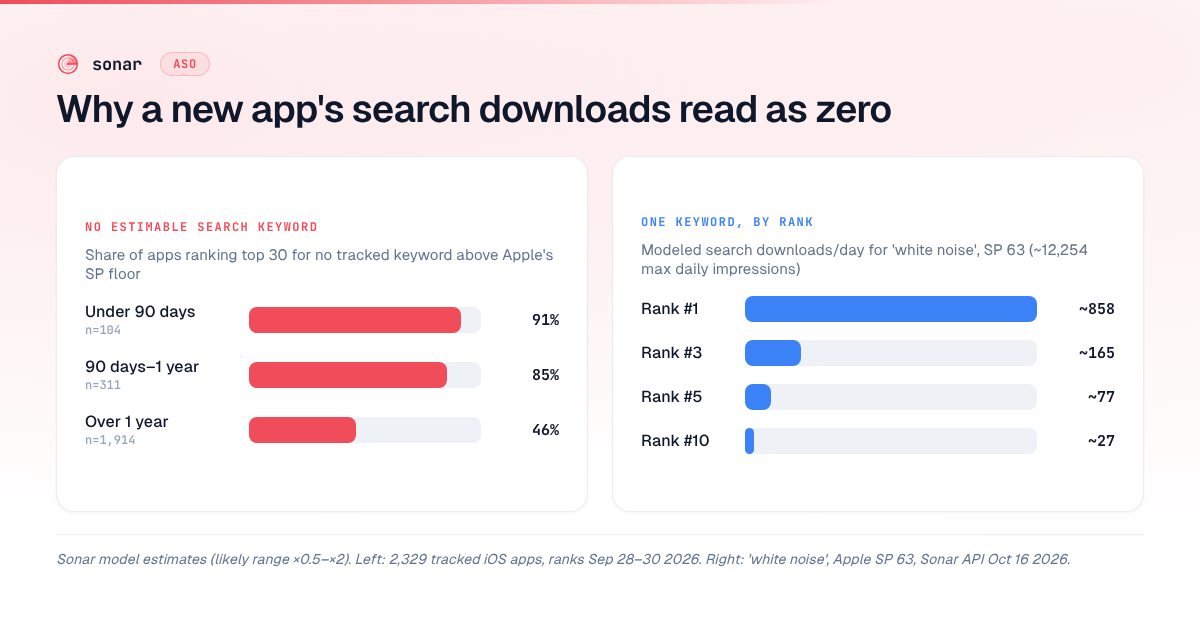
In Sonar's data, 91.3% of iOS apps under 90 days old didn't rank top 30 for a single tracked keyword with measurable Apple search popularity. They ranked for a median of 11 keywords each; Apple just couldn't measure the demand. That is why "is 150 downloads in two months normal?" has no useful answer as a benchmark, and a very useful answer as a calculation.
This post replaces anecdotes with a method, then applies it to 2,329 real apps.
By Peter. Sonar API sample run October 16, 2026; database figures from ranks Sep 28–30, 2026.
How many downloads should a new app get? The short answer
9 in 10 new iOS apps rank for no keyword with measurable Apple demand (Sonar data, n = 104), so there is no fair benchmark for how many downloads a new app should get. Organic search downloads are capped by the demand of the keywords you rank for, not by your app's age. Ranking #1 for "white noise" models at roughly 858 search downloads a day (estimate, ×0.5–×2); ranking #1 only for floor-popularity terms models at "too small to estimate" (Sonar model v0, Apple popularity read October 16, 2026).
So the honest answer to how many downloads a new app should get is whatever your keyword ceiling says. For most new apps that's close to nothing in the first 90 days: normal, and often fixable.
The method: your organic search ceiling, keyword by keyword
Your organic search ceiling is the sum, over every keyword you rank for, of that keyword's impressions times the share your rank captures. Three inputs:
- Impressions from Apple Search Popularity. SplitMetrics fit Apple's 5–100 Search Popularity score to impressions: max daily impressions = 254.4443 × e^(0.0615 × SP) (SplitMetrics). The full SP-to-impressions reference table lives in our Apple Search Popularity guide.
- Share captured at your rank. Sonar's model v0 folds tap and install into one number: 0.07 of max impressions at rank #1, scaled by rank^-1.5 below that (#3 gets about 19% of #1, #10 about 3%).
- Ranks 1–30 only. Below #30, the model counts nothing.
Be clear about step 2: it is an industry prior, not a measured curve. We found no published measured organic tap-share-by-position curve as of October 2026. Our shape sits between SplitMetrics' 2018 tap-through test (#2 at about 0.22 of #1, #3 at about 0.09; SplitMetrics) and RespectASO's hand-tuned power law (#2 at about 0.6, #3 at about 0.4; RespectASO on GitHub). Treat every output as an estimate with a likely range of ×0.5 to ×2.
A worked ceiling table for 12 real keywords
The model applied to 12 common keywords, with Apple popularity and Sonar difficulty from the Sonar API (US, popularity_source: apple, October 16, 2026). Downloads are modeled per day, ×0.5 to ×2.
| Keyword | Apple SP | Difficulty | Max impressions/day | #1 | #3 | #10 | #30 |
|---|---|---|---|---|---|---|---|
| white noise | 63 | 77 | ~12,254 | ~858 | ~165 | ~27 | ~5 |
| habit tracker | 56 | 73 | ~7,967 | ~558 | ~107 | ~18 | ~3 |
| meditation | 52 | 82 | ~6,230 | ~436 | ~84 | ~14 | ~3 |
| sleep sounds | 50 | 79 | ~5,509 | ~386 | ~74 | ~12 | ~2 |
| budget planner | 50 | 63 | ~5,509 | ~386 | ~74 | ~12 | ~2 |
| tip calculator | 47 | 40 | ~4,581 | ~321 | ~62 | ~10 | ~2 |
| packing list | 5 | 32 | not estimable | – | – | – | – |
| chore chart | 5 | 38 | not estimable | – | – | – | – |
| vision board | 5 | 51 | not estimable | – | – | – | – |
| pollen count | 5 | 40 | not estimable | – | – | – | – |
| debt tracker | 5 | 34 | not estimable | – | – | – | – |
| baby names | 5 | 39 | not estimable | – | – | – | – |
Look at difficulty. Five of the six measurable terms carry difficulty 63–82; only "tip calculator" (40) is measurable and moderate. Every easy term sits at Apple's floor of 5. That is the new-app trap: the keywords you can win have no measurable demand, and the ones with demand are hard.
SP 5 does not mean zero searches. It means below Apple's measurement resolution, and 98.0% of the ~1.67 million iOS keywords Sonar holds an Apple popularity reading for sit there (Sonar data, keyword_apple_sp, October 1, 2026). Whether a floor keyword is still worth targeting is covered in is popularity 5 a no-go?.
Do the calculation for your own keywords
For each keyword where you rank top 30 and Apple SP is above 5:
downloads/day ≈ 254.4443 × e^(0.0615 × SP) × 0.07 × rank^-1.5
Worked example: a keyword at SP 55 where you rank #12. Impressions ≈ 254.4443 × e^(3.38) ≈ 7,492. At #1 that's 7,492 × 0.07 ≈ 524. At #12, multiply by 12^-1.5 ≈ 0.024: about 12.6 downloads a day, so somewhere between ~6 and ~25.
Add the rows up, leaving out your brand name (that's people who already know you, not discovery).
One rank caveat: Sonar's iOS ranks come from the iTunes Search API, which orders by text relevance. An August 2026 check against DataForSEO's true App Store ranks found head terms agree but tail terms read 20–40 places too optimistic (Sonar data). Treat tail-term ranks as best case.
What Sonar's data shows for new vs established apps
Sonar applied the same model to 2,329 tracked iOS apps, using each app's best rank per tracked keyword over Sep 28–30, 2026, brand keywords excluded (Sonar data). Every figure is a modeled estimate of non-brand search downloads, ×0.5 to ×2, not a measured count.
| App age | n | Median ratings | Median keywords ranked top 30 | No estimable keyword | Median search downloads/day (all storefronts) | p75 | p90 |
|---|---|---|---|---|---|---|---|
| Under 90 days | 104 | 0 | 11 | 91.3% | too small to estimate | too small | too small |
| 90 days to 1 year | 311 | 5 | 17 | 85.2% | too small to estimate | too small | ~12 |
| 1 year or more | 1,914 | 2,600 | 78.5 | 46.3% | ~3.8 | ~143 | ~860 |
"No estimable keyword" means every keyword the app ranks for is at Apple's floor of 5, ranked below #30, or a brand term. For US keywords alone it is worse: 96.2% of new apps had no estimable keyword, and even the established US median is too small to estimate, with p75 ~26 and p90 ~197 a day (Sonar data, same window).
What it means
A typical new app ranks, just for keywords Apple can't measure. Ranking is not the bottleneck; demand-weighted ranking is. Established apps rank top-30 for about seven times as many keywords (78.5 vs 11), and roughly half of them reach at least one term with measurable demand.
Even the established median models at only about 4 non-brand search downloads a day. The top quarter clears ~143 and the top tenth ~860.
Only keywords someone tracks in Sonar count, so these figures understate coverage. Per-category figures for new apps are suppressed: the cells are too small to publish.
Established apps by category: where search pays
For apps older than a year, category moves the median a little and the top quarter a lot (Sonar data, ranks Sep 28–30, 2026, categories with at least 20 established apps). Figures are modeled non-brand search downloads per day, all storefronts, ×0.5 to ×2.
| Category | n | Median/day | p75/day | No estimable keyword |
|---|---|---|---|---|
| Health & Fitness | 423 | ~11 | ~189 | 40.4% |
| Games | 399 | ~9.3 | ~160 | 39.8% |
| Productivity | 146 | ~9.5 | ~232 | 41.8% |
| Lifestyle | 142 | too small | ~60 | 56.3% |
| Education | 129 | too small | ~126 | 51.2% |
| Utilities | 110 | too small | ~73 | 51.8% |
| Finance | 93 | ~4.9 | ~163 | 46.2% |
| Photo & Video | 72 | ~4.3 | ~317 | 44.4% |
| Food & Drink | 54 | too small | ~4.3 | 74.1% |
| Entertainment | 48 | ~13 | ~251 | 35.4% |
| Medical | 47 | too small | ~14 | 63.8% |
| Travel | 45 | ~20 | ~311 | 40.0% |
| Social Networking | 39 | too small | ~40 | 61.5% |
| Business | 38 | too small | ~240 | 52.6% |
| Reference | 32 | ~2.6 | ~45 | 43.8% |
| Music | 25 | too small | ~41 | 56.0% |
| Sports | 21 | too small | ~1.5 | 76.2% |
In Food & Drink, Sports and Medical, about two-thirds or more of year-old apps have no estimable search keyword.
Why a second estimate disagrees by 30x
Sonar's revenue estimator gives a different kind of download number: lifetime average downloads from rating count × the category's review-to-install ratio ÷ app age. More than half of new apps (53.8%) have no ratings yet, so this ratings-based estimate has nothing to work with; the top quarter models at ~7 a day or more and the top tenth at ~44. Established apps model at a median of ~119 a day (Sonar data, same apps; all estimates, ×0.5–×2).
That is about 30 times the search model's ~3.8. Don't average them: one counts current non-brand search, the other every source over the app's life. The gap is what the search model excludes: brand search, browse, featuring, web and paid installs.
150 users after 2 months. Is that normal for a solo indie developer?
Yes, 150 users in 2 months, about 2.5 a day, is a plausible result for a new iOS app. On Sonar's ratings-based lifetime estimate, more than half of apps under 90 days old (53.8%) have no ratings yet to estimate from, and the top quarter models at ~7 a day or more (Sonar data, n = 104, ranks Sep 28–30, 2026; estimate, ×0.5–×2). 2.5 a day sits below that top quarter.
In developer forum threads, the answers ("about 50 a month", "130 in a month and a half") cluster in the same band, but they can't tell you whether yours came from search. App Store Connect's App Analytics splits downloads by source, including App Store Search, App Store Browse, web referrer and app referrer (Apple: view acquisition sources; our walkthrough). If most of your 150 came from launch posts, search hasn't kicked in yet; the ceiling calculation tells you whether it can.
How many naturally occurring downloads to expect?
Naturally occurring downloads from ASO equal your keyword ceiling: the sum of popularity-weighted, rank-discounted downloads across terms you rank top 30 for. For 91.3% of new iOS apps in Sonar's data that sum has no estimable term in it, so expect organic search to be small until you rank for at least one keyword above Apple's floor (Sonar data, n = 104).
So when you ask how many downloads a new app should get from ASO, the lever is one measurable keyword ranked well, not dozens of floor terms. A single #10 rank for "tip calculator" models at ~10 a day (estimate, ×0.5–×2); #1 for six SP-5 terms models at nothing estimable.
A realistic sequence for a new app:
- Rank #1 for your own name in every storefront.
- Find one or two terms above SP 5 with moderate difficulty, like "tip calculator" at difficulty 40, and target them in your title and subtitle.
- Hold the floor-popularity long-tail terms you already win. Their traffic is below Apple's resolution, not necessarily zero.
For what to do next, see how to increase app downloads.
My iOS app has 0 downloads after a month of launch attempts
Zero downloads after a month is one of two problems: a fixable zero, where search doesn't surface the app, or a no-demand zero, where every term you rank for sits at Apple's popularity floor of 5. Diagnose which first.
Fixable zeros
| Symptom | What it means | Fix |
|---|---|---|
| App doesn't appear for its own name | Not indexed in that storefront, or a generic brand word | Follow the app not showing in App Store search checks |
| Ranks only for its own name | Metadata targets no non-brand terms | Put real search terms in title, subtitle and keyword field |
| Ranks only for crowded head terms, at #30 or below | Targeting terms with difficulty 70+ | Swap one head term for a measurable moderate-difficulty term |
The third row is the common trap: #30 for "habit tracker" models at ~3 downloads a day (estimate, ×0.5–×2).
No-demand zeros
If you're indexed, rank top 10, and every term reads SP 5, the store is working; demand is just below Apple's resolution. More ASO won't fix that. Reposition your wording toward searched terms, or plan for discovery outside search. Our app launch strategy guide covers which channels to line up.
What about Google Play?
This model is iOS only: it is calibrated to Apple Search Popularity, and Google Play publishes no equivalent per-keyword score, so there is no Play version.
FAQ
How many downloads should a new app get in its first month?
There is no universal number. In Sonar's data, more than half of new iOS apps (53.8%) have no ratings yet for a ratings-based estimate, and the top quarter models at ~7 downloads a day or more (n = 104, Sep 2026; estimate, ×0.5–×2). Your own ceiling depends on the Apple popularity of the keywords you rank for.
Is zero downloads normal for a new app?
Having no estimable search downloads is common: 91.3% of new iOS apps in Sonar's data had no estimable search keyword. Zero total downloads after a month usually means either the app isn't surfaced in search (fixable) or it ranks only for floor-popularity terms.
How accurate is the downloads-per-keyword model?
Treat it as ×0.5 to ×2. The impressions formula comes from SplitMetrics' fit of Apple Search Popularity; the share captured at each rank is a prior, not a measured curve, because we found no published measured curve as of October 2026.
Does Apple popularity 5 mean nobody searches for my keyword?
No. SP 5 is Apple's floor: below its measurement resolution, not zero searches. 98.0% of the ~1.67 million iOS keywords in Sonar's data sit there.
Want to run this calculation across every keyword you rank for, with Apple's popularity and your daily rank side by side? Sonar tracks both for your iOS apps on the Indie and Agency plans. Start free trial.