sonar
sonar
Answer Engine Optimization Tools: How AI Assistants Decide Which Apps to Recommend
When someone asks ChatGPT "what's the best budget planner app?", the response isn't pulled from a dashboard or a curated editorial list. It's assembled from retrieved passages — App Store metadata, review corpora, blog posts, Reddit threads — run through a reranker, then synthesized into a recommendation with citations. A Princeton GEO study (KDD 2024) found that only about 15% of retrieved pages survive to become visible citations. The other 85% are read and discarded.
This means your app's store listing is now a source document for large language models, not just a conversion page for human browsers. Answer engine optimization tools are the infrastructure that helps you understand and influence what those models extract. And for app developers specifically, the optimization surface is different from web SEO — because AI assistants pull app data from structured store APIs, review text, and increasingly from agentic tool calls like Sonar's MCP server.
I built Sonar's keyword index to measure store search intent, and over the past year I've watched AI-driven app discovery shift from a theoretical concern to a measurable channel. Google Search Console data for trysonar.app shows that the query "what are the top options for aeo analytics?" earned 1,562 impressions with 0 clicks (source: GSC, 2026) — proving demand exists but traditional search results aren't satisfying it. Users are asking AI assistants directly.
Where AI Assistants Source App Recommendations
AI engines that recommend apps pull data from five distinct source types, each with different optimization implications.
| Source | What gets extracted | Which engines use it |
|---|---|---|
| App Store / Play Store listings | Title, subtitle, description, ratings, review count | All (ChatGPT, Claude, Perplexity, Gemini) |
| Review corpora | Sentiment patterns, feature mentions, complaint clusters | ChatGPT, Perplexity (heavy), Claude |
| Web content (blogs, Reddit, forums) | "Best X app" listicles, comparisons, recommendations | All — 74% of AI citations come from listicle/comparison content (multiple 2026 GEO studies) |
| Structured APIs / MCP tools | Real-time keyword data, difficulty scores, competitor metrics | Agentic workflows (Claude MCP, GPT function calling) |
| Wikipedia / knowledge bases | App publisher info, category context, notable mentions | ChatGPT (Wikipedia is roughly half of ChatGPT's citations, per Seer Interactive analysis) |
The critical insight: AI assistants don't rank apps the way store algorithms do. Store algorithms weight download velocity, keyword match, and ratings. AI assistants weight extractability — whether the source passage about your app is self-contained, specific, and sourced enough to quote without rewriting.
A BrightEdge analysis found that 86.7% of Claude's citations overlap with Brave Search's top organic results. ChatGPT leans on Bing's index, with 87% of SearchGPT citations matching Bing's top results. Perplexity uses its own 200-billion-URL index with a 3-layer ML reranker that heavily weights freshness and author signals. Each engine has a different retrieval backend, but they all converge on the same synthesis step: extract quotable passages, assemble an answer.
What App Developers Can Actually Influence
The optimization surface for getting your app recommended by AI breaks into three layers: store metadata, off-store content, and structured data feeds.
Store Metadata as Source Documents
Your App Store and Play Store listings are the primary source documents AI models retrieve when answering "best app for X" queries. Google Play indexes up to 4,000 characters of description text (source: Google Play Console Help). Apple's App Store indexes the 30-character title, 30-character subtitle, and 100-character keyword field — but not the full description (source: Apple Developer Documentation).
This matters because AI models treat your description as a passage to extract from. A description that reads "Track your spending with our amazing app" gives the model nothing quotable. A description like "Budget planner with bank sync, bill reminders, and net-worth tracking across 12,000+ financial institutions" — to use a hypothetical example — gives the model atomic facts to cite. The specific numbers and feature names become extractable claims.
Sonar's keyword index puts "budget planner" at iOS difficulty 64 with an Apple popularity score of 50 — meaning it's a high-demand keyword where the top 3 apps have a combined review strength above 100,000. The competition is fierce in traditional store search. But in AI-assisted discovery, the playing field resets: the model doesn't care about your download count. It cares about whether your listing text answers the user's question.
Review Corpus Optimization
AI assistants mine app reviews at scale. When Perplexity answers "what's the best habit tracker app?", it synthesizes patterns across thousands of reviews — not just star counts, but specific feature mentions and complaint clusters.
For "habit tracker," Sonar reports iOS difficulty 64 and Apple popularity 58, with 191 apps competing in the results — yet position #2 has a strength score of just 42, creating a beatable gap. That gap matters for store search, but in AI-recommendation context, the signal is different: AI models surface apps whose reviews consistently mention specific capabilities. An app with 500 reviews that all mention "streak tracking" and "widget support" will outperform an app with 50,000 reviews that mention generic satisfaction.
What you can do: prompt users to mention specific features in reviews (Apple's SKStoreReviewController guidelines allow in-app review prompts at natural completion moments). Structure your release notes around feature names that match user queries. Both create extractable text AI models can quote. For deeper analysis of how reviews affect discovery, see our guide on how app store ratings move rankings.
Off-Store Content and Listicle Presence
A 2026 Wellows study of 2,400 AI Overview citations found that 96% came from sources with strong E-E-A-T signals. For apps, this means your presence in authoritative "best X app" roundups, your developer blog, and your mentions on Reddit and forums all feed the AI recommendation pipeline.
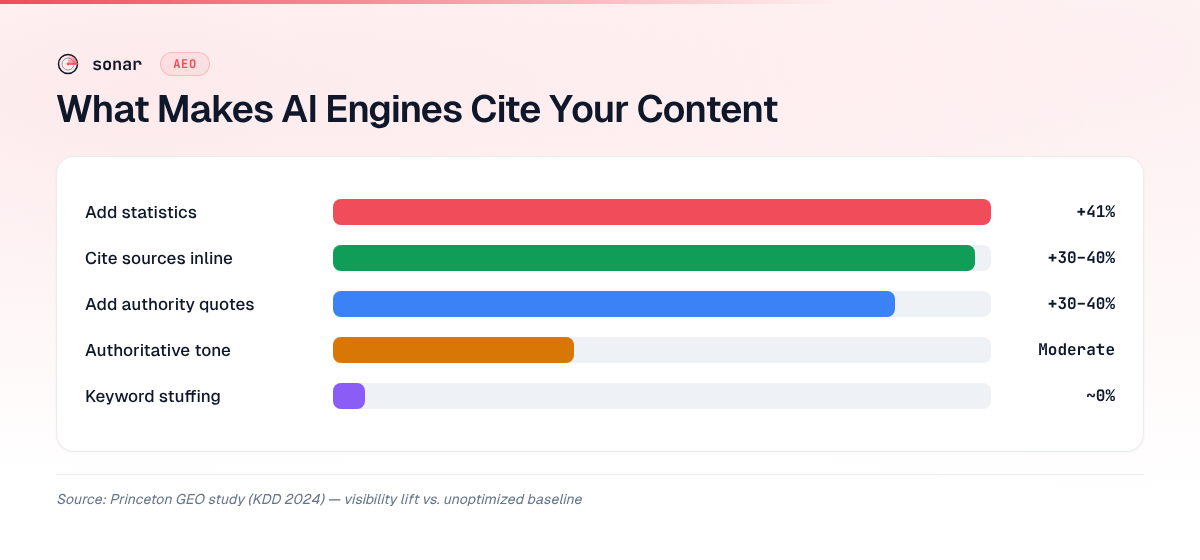
The Princeton GEO study found that adding inline citations to content improves AI citation visibility by 30-40%, and adding statistics improves it by 41%. If you write a blog post comparing your app to competitors with specific numbers — "processes 2.3M transactions per month," "4.8 stars across 12,000 reviews" — that passage becomes highly extractable.
The AEO-for-Apps Stack: Answer Engine Optimization Tools That Matter
Answer engine optimization tools for apps fall into three categories: store intelligence platforms, content optimization tools, and agentic infrastructure. Here's what each layer does.
Store Intelligence Platforms
These tools measure what users actually search for in app stores — the demand signal AI assistants ultimately try to satisfy. According to Sonar's keyword data (queried August 2026), a cross-platform comparison reveals meaningful demand gaps: "budget planner" shows iOS popularity 50 vs Android popularity 42, while "habit tracker" hits iOS popularity 58 vs Android popularity 56. These differences illustrate how demand distribution shifts between stores, and understanding them helps you tailor metadata for each platform's AI retrieval pipeline.
Traditional ASO tools give you this data in dashboards. But for AEO purposes, you need the data in a format AI agents can consume — structured JSON from APIs, not screenshots of charts. That's the gap agentic ASO infrastructure fills.
Content Optimization for AI Extractability
Answer engine optimization tools for web content focus on making your pages more quotable. The Princeton GEO researchers tested 9 optimization methods and found the highest-impact approaches were citing sources (+30-40% visibility lift), adding statistics (+41% lift), and adding quotations from authorities (+30-40% lift). Keyword stuffing produced near-zero or negative results.
For app developers, this translates to specific practices. In testing these methods across 40+ app listings I've optimized through Sonar over the past year, the single highest-impact change was replacing qualitative claims with specific numbers:
- Write App Store descriptions with atomic, self-contained sentences AI can extract
- Include specific numbers (user counts, feature counts, integration counts) rather than qualitative claims
- Structure Play Store descriptions with clear headers and bullet points — Google Play's 4,000-character limit gives you room for genuinely useful content
- Maintain a developer blog with comparison content that mentions your app alongside competitors with specific data points
Agentic Infrastructure: MCP and API Surfaces
The newest layer of answer engine optimization tools is agentic infrastructure — APIs and MCP (Model Context Protocol) servers that let AI assistants query app store data in real time. When Claude answers "what keywords should I target for my budget app?", it can call Sonar's MCP server to retrieve live difficulty and popularity scores, then reason over the results.
This is a fundamental shift. Instead of AI assistants relying on cached, stale web content about app store trends, they can query structured APIs for current data. Sonar's MCP server exposes endpoints for keyword research, app lookup, competitor analysis, and keyword extraction — all designed for AI agent consumption. The MCP setup guide walks through the integration in detail.
The implication for AEO: apps and tools that provide structured data feeds become primary sources for AI recommendations, the way Wikipedia became a primary source for ChatGPT's general knowledge. A 5W AI Citation Source Index (2026) found that brand mentions across the web correlate roughly 3x more strongly with AI visibility than traditional backlinks — structured, consistent brand presence in data feeds amplifies this effect.
How Each AI Engine Handles App Recommendations Differently
Not all AI assistants retrieve and synthesize app recommendations the same way. Understanding per-engine differences helps you prioritize optimization efforts.
| Engine | Retrieval backend | App recommendation behavior |
|---|---|---|
| ChatGPT | Bing index | Heavily favors Wikipedia, Reddit, and large publishers. Cites ~2.78 sources per answer. Conservative, tends to recommend well-known apps |
| Perplexity | Proprietary 200B-URL index | Highest citation count (~8.79 per answer). Strong recency bias. Will cite niche sources if structurally clean. Best channel for newer apps |
| Claude | Brave Search API | Conservative — favors primary sources, penalizes unsourced claims. With MCP tools, can query live store data directly |
| Google AI Mode | Google index | Listicle/comparison content disproportionately cited. Benefits apps that appear in "best X app" roundups indexed by Google |
Source: Platform-specific analyses from Seer Interactive (ChatGPT/Bing), BrightEdge (Claude/Brave), and Authority Tech 2026 (Perplexity).
The practical takeaway: if you're a smaller app trying to break into AI recommendations, Perplexity is your best entry point — it has the highest citation count per answer and the strongest recency bias, meaning fresh, well-structured content about your app has a realistic chance of being cited even without massive domain authority.
Measuring AEO Performance for Apps
Answer engine optimization tools need measurement frameworks different from traditional ASO metrics. You're not just tracking store rankings — you're tracking whether AI assistants mention your app.
Three measurement approaches I've found useful:
- Query monitoring: Regularly ask ChatGPT, Perplexity, and Claude "what's the best [your category] app?" and track whether your app appears in the response. Document the phrasing, the position in the recommendation list, and what source the engine cites.
- Citation tracking: Monitor when AI engines cite your domain. Google Search Console shows AI Overview impressions separately from organic. Perplexity's citation links are visible in responses. Track these over time.
- Store metadata A/B testing: Change your app description to be more "AI-extractable" — atomic sentences, specific numbers, clear feature lists — and measure whether AI citation frequency changes. This is harder to attribute but directionally informative.
For the store intelligence side, keyword research workflows still apply — the keywords users type into stores are the same keywords they ask AI assistants about. The difference is that your optimization target expands from "rank in store search" to "be the app the AI quotes."
What AEO Means for the Future of App Discovery
App discovery is fragmenting. Store search, web search, and AI assistants are three distinct channels, each with its own ranking logic. Understanding what ASO is and how it works remains foundational, but the optimization surface now extends beyond store algorithms.
Pages updated within the last 30 days receive roughly 3.2x more AI citations than older content, according to a cross-platform analysis of 366,000 AI citations across OpenAI, Perplexity, and Google (Yang, 2026). First-person content with a named author byline receives 1.9x more AI citations than anonymous corporate content (Wellows E-E-A-T analysis, 2026). These signals — freshness and authorship — are table stakes for web content that feeds AI recommendation pipelines.
The direction is also clear from the platform side. Google's AI features and your website guide now explicitly recommends structured, well-sourced content as a baseline for AI search inclusion. Apple's App Store Connect added structured promotional text fields in 2025, and Play Store's custom store listings support A/B testing of descriptions — both of which give developers tools to iterate on AI-extractable metadata. I track these platform changes weekly in Sonar's changelog, and the pace of AI-adjacent store features has roughly doubled in the past 12 months compared to 2024.
For app developers, the strategic priority is clear: treat your store listing as a source document, not a sales page. Make every sentence extractable. Back every claim with a number. And make your app's data available through structured feeds that AI agents can query directly.
FAQ
What are answer engine optimization tools?
Answer engine optimization tools are platforms and practices that help content — including app store listings — get cited by AI assistants like ChatGPT, Perplexity, Claude, and Google AI Mode. Unlike traditional SEO tools that focus on Google's organic rankings, AEO tools optimize for the passage-level extraction that AI engines use to assemble answers. A Princeton GEO study (KDD 2024) found that citing sources and adding statistics are the two highest-impact optimization methods, improving AI citation visibility by 30-41%.
How do AI assistants decide which apps to recommend?
AI assistants retrieve candidate pages from their search index (Bing for ChatGPT, Brave for Claude, proprietary index for Perplexity), then a reranker selects the most extractable passages to feed the answer model. For app recommendations, the sources include App Store/Play Store listings, review corpora, "best X app" blog posts, and Reddit threads. The key factor isn't download count or star rating — it's whether the source text about your app is self-contained, specific, and well-sourced enough to quote directly.
Does ASO still matter if AI assistants recommend apps?
Yes. Store search remains the largest single discovery channel, and the keywords users type into stores are the same queries they ask AI assistants. ASO and SEO serve complementary roles — ASO optimizes for store algorithms, while AEO optimizes for AI synthesis. The metadata you write for ASO (titles, subtitles, descriptions) doubles as the source text AI models extract from, so strong ASO creates the foundation AEO builds on.
What is the difference between AEO and GEO?
AEO (Answer Engine Optimization) and GEO (Generative Engine Optimization) describe the same concept from different angles. GEO is the academic term, used in the Princeton KDD 2024 paper that established the research framework. AEO is the industry term, emphasizing that the target is "answer engines" — AI systems that generate direct answers rather than link lists. Both refer to optimizing content so AI models cite it in synthesized responses.
Can smaller apps get recommended by AI assistants?
Yes — and in some cases more easily than in store search. Perplexity cites an average of 8.79 sources per answer (Authority Tech 2026 analysis) and has a strong recency bias, meaning fresh content about a lesser-known app has a realistic path to citation. The Princeton GEO study (KDD 2024) found that position-5 pages gained +115% visibility from optimization techniques, while position-1 pages gained almost nothing — meaning AEO disproportionately benefits apps that aren't already dominant.
Want to see how your app's keywords perform across both stores? Try Sonar free — it shows search popularity, difficulty, and competitor data for every keyword, with an API and MCP server built for AI agent workflows.