
You Already Know Half of ASO
If you've done any SEO work — optimized a landing page, researched keywords, tracked rankings — you already understand the core logic of App Store Optimization. The platforms differ and the ranking signals shift, but the strategic thinking is the same: figure out what people search for, make your content match those queries, and earn signals that tell the algorithm you deserve to rank.
This article is the bridge. It maps every major SEO concept to its ASO equivalent so you can start optimizing app store listings with the knowledge you already have.
The Side-by-Side Comparison
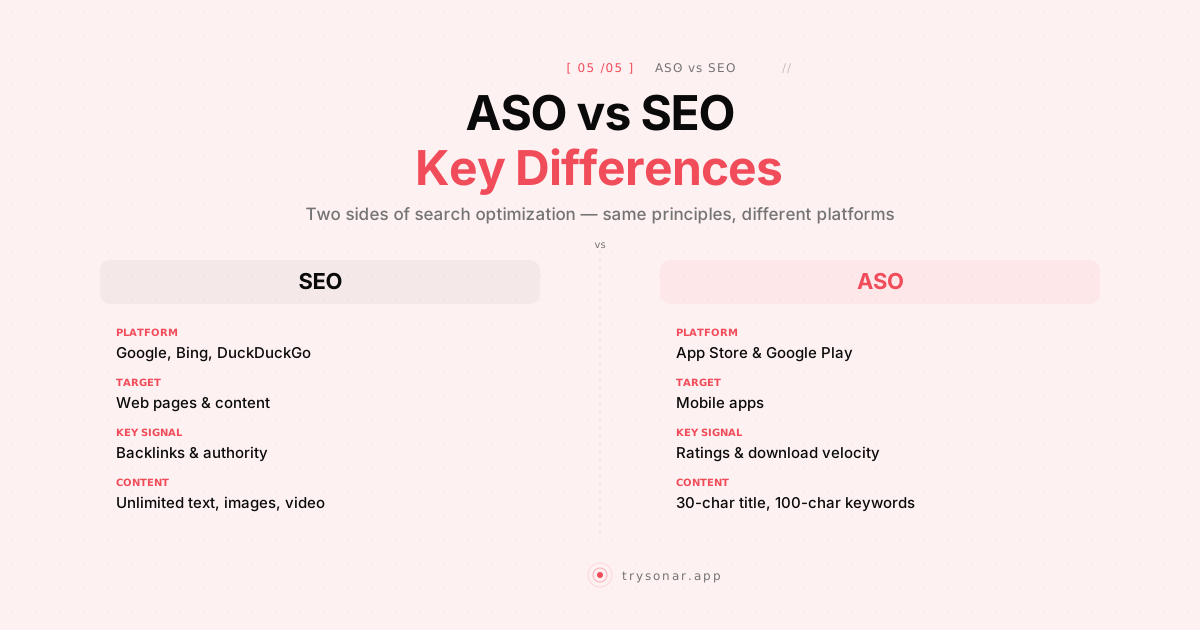
Here's how the two disciplines break down across every major dimension:
| Dimension | SEO (Google Search) | ASO (App Store / Google Play) |
|---|---|---|
| Goal | Rank web pages in search results | Rank apps in store search results |
| Primary platform | Google (+ Bing, etc.) | Apple App Store, Google Play Store |
| Indexed content | Full page content, meta tags, headers, links | App title, subtitle, keyword field (iOS), description (Android) |
| Keyword research | Search volume, keyword difficulty, SERP analysis | Search popularity, keyword difficulty, top-10 competitor analysis |
| On-page optimization | Title tags, meta descriptions, headers, body content | App title, subtitle, keyword field, description, screenshots |
| Content length | Longer content often performs well (1,000-3,000+ words) | Strict character limits: 30 chars (title), 30 chars (subtitle), 100 chars (keyword field on iOS) |
| Backlinks equivalent | Inbound links from other websites | Download velocity, app referrals, external links to store listing |
| Technical SEO equivalent | Site speed, Core Web Vitals, mobile-friendliness, crawlability | App size, crash rate, load time, iOS/Android version support |
| User signals | Click-through rate, bounce rate, dwell time | Conversion rate (impressions to installs), retention, uninstall rate |
| Reviews/ratings | Google Business reviews affect local SEO | Ratings and reviews directly affect rankings on both stores |
| Content updates | Fresh content improves rankings | Regular app updates signal active maintenance |
| Rich results | Schema markup, featured snippets | Custom product pages (iOS), store listing experiments (Android) |
| Local optimization | Google Business Profile, local keywords | Per-country keyword and metadata localization |
| Paid complement | Google Ads (SEM) | Apple Search Ads, Google App Campaigns |
| Ranking volatility | Algorithm updates can shift rankings overnight | More stable; changes tied to metadata updates and competitor activity |
| Time to rank | Weeks to months for competitive terms | Days to weeks; metadata changes reindex within 24-48 hours |
| Primary conversion | Click to website (then further funnel) | Impression to install (single step) |
Where SEO Skills Transfer Directly
If you've done SEO, several skills carry over to ASO with almost no translation needed.
Keyword Research
The process is nearly identical. You brainstorm seed keywords, expand them with autocomplete suggestions and related terms, evaluate each one on volume and competition, and pick the best targets. If you've ever used Google Keyword Planner to find a long-tail keyword with decent volume and a low KD score, you already know the workflow. In ASO, you're doing the same thing — just with App Store search popularity instead of monthly Google search volume. Try browsing our keyword difficulty pages — for example, the typing practice keyword difficulty page — to see how this data looks in practice.
One difference worth noting: app store keyword data is less granular. Google gives you monthly search volumes in the thousands ("budget tracker" = 14,800/mo). Apple gives you a Search Popularity score from 5 to 100 — a relative index, not an absolute count. A score of 50 means moderate demand; a score of 80 means significant traffic. You work with what's available, but the analytical framework — find the intersection of high volume and low difficulty — is exactly the same skill you already have.
Competitive Analysis
In SEO, you plug a competitor's domain into Ahrefs and see every keyword they rank for. In ASO, the equivalent is pulling up a competitor app and analyzing their metadata — what keywords are in their title, subtitle, and keyword field, and which search terms return them in the top 10. The concept of a "keyword gap" — terms your competitors rank for that you don't — works exactly the same way in both worlds. If a rival habit tracker ranks for "daily routine" and you don't, that's a gap worth closing.
Rank Tracking and Conversion Optimization
You track keyword positions over time, watch for drops, and correlate changes with your optimization efforts. The cadence is similar (daily or weekly checks). The response to a ranking drop is similar (diagnose whether it's a metadata issue, a competitor move, or an algorithm change). If you're also tracking how your marketing site ranks on Google, a web SEO rank tracker covers that side; for app store positions you'd pair it with an ASO tracker. The muscle memory is the same either way — watch positions, spot movement, react.
Conversion optimization also transfers directly. In SEO, you optimize title tags and meta descriptions to improve click-through rates. In ASO, you optimize your app icon, screenshots, and subtitle to improve the conversion from store impression to install. Google Play even offers built-in A/B testing for store listings (called "store listing experiments"), which is the direct equivalent of running CRO tests on a landing page.
Where ASO Diverges from SEO
Several aspects of ASO have no direct SEO parallel. These are the areas where web developers need to build new intuition.
The 160-Character Constraint (iOS)
On iOS, your entire keyword footprint fits into 160 characters: 30 for the title, 30 for the subtitle, and 100 for the hidden keyword field. That's it. Apple doesn't index your description for search. Every character is precious, and you can't just "write more content" to target more keywords like you would with a web page.
This constraint makes ASO a more surgical discipline than SEO. Instead of writing a 2,000-word article that naturally covers dozens of keywords, you're selecting 15-20 individual terms and fitting them into a space smaller than a tweet. Our metadata optimization guide walks through exactly how to make the most of those characters.
Word Combination Matching (iOS)
Apple combines words across your title, subtitle, and keyword field to match multi-word queries. If "budget" is in your title and "tracker" is in your keyword field, you can rank for "budget tracker" even though those words appear in different fields.
This means you should never repeat a word across fields — it wastes characters. If "budget" appears in both your title and keyword field, you've burned characters for zero benefit. SEO has no equivalent to this combinatorial behavior. Google indexes each page as a whole, and keyword placement in specific fields (title vs. body) affects weight, but there's no cross-field matching mechanic to exploit.
Visual Conversion Assets
Your app icon, screenshots, and preview video directly affect whether someone installs your app. There's no real SEO equivalent. In web search, users decide to click based on the title and description snippet. In app stores, visual design is a first-class ranking input because it affects conversion rate, and conversion rate affects rankings.
Ratings as a Hard Ranking Factor
App ratings (the 1-5 star score) directly influence search rankings. An app with a 4.7 rating will consistently outrank a similar app with a 3.9 rating, all else being equal. In SEO, Google Business reviews matter for local search, but there's no equivalent star-rating signal for organic web results.
No Link Building
Here's something SEO practitioners will find refreshing: ASO has no link building. No guest posting, no link outreach, no domain authority to accumulate over years. App store rankings are determined by your metadata, your quality signals (ratings, reviews, retention), and download velocity. A solo developer with a great app and smart keyword choices can outrank a well-funded company.
Two Platforms, Two Rule Sets
ASO is really two disciplines. iOS ASO and Android ASO have fundamentally different indexing rules, and this is one of the biggest surprises for SEO practitioners who are used to optimizing for one dominant search engine.
Google Play works more like web SEO. Google indexes your full app description (up to 4,000 characters), so you can weave keywords naturally into longer-form copy — similar to writing a web page. Keyword density, natural language, and topical depth all matter.
iOS works nothing like web SEO. Apple ignores your description entirely for search indexing. Your only searchable real estate is the title (30 chars), subtitle (30 chars), and a hidden keyword field (100 chars). It's less like writing a blog post and more like writing a classified ad.
This means your optimization strategy for each store should be fundamentally different, even for the same app. SEO people who try to apply a single approach to both stores will underperform.
The "If You Know X, You Already Understand Y" Cheat Sheet
| SEO concept you know | ASO equivalent |
|---|---|
| Title tag | App title (30 chars) |
| Meta description | App subtitle (30 chars, iOS) or short description (80 chars, Android) |
| Body content keywords | Keyword field (100 chars, iOS) or long description (4,000 chars, Android) |
| Google Search Console | App Store Connect / Google Play Console |
| Google Keyword Planner | Apple Search Ads keyword tool / ASO tools like Sonar |
| Ahrefs / SEMrush | ASO tools (keyword research, rank tracking, competitor analysis) |
| Domain authority | App authority (install count, review count, rating, age) |
| Backlinks | Download velocity + external referral traffic |
| Click-through rate | Tap-through rate (impressions to product page views) |
| Core Web Vitals | App performance metrics (crash rate, load time, app size) |
| Hreflang tags | App Store localization (per-country metadata) |
| Google Ads | Apple Search Ads / Google App Campaigns |
| Featured snippets | Featured apps / editorial stories (not keyword-driven, though) |
| Schema markup | App store structured fields (category, age rating, in-app purchases) |
Why You Need Both
If you're building a product that has both a website and a mobile app — which is increasingly common — you need both SEO and ASO working together.
SEO drives awareness. Someone searching "best habit tracking apps 2026" on Google might land on your blog post, discover your product, and install the app. Your website acts as a top-of-funnel channel that feeds app installs.
ASO drives installs. Someone searching "habit tracker" directly in the App Store has high purchase intent. They're not researching — they're ready to download. ASO puts you in front of these users at the exact moment of decision.
They reinforce each other. External traffic to your App Store listing (from your website, social media, or press) improves your download velocity, which improves your ASO rankings. Better ASO rankings drive more installs, which gives you more users to write reviews, which improves your star rating, which further improves rankings. It's a flywheel.
Even if you only have a mobile app today, a simple landing page that ranks for "[your category] app" on Google can drive meaningful installs. Getting it to rank is its own small project — a tool like Boomranq turns a site into a prioritized, keyword-driven publishing calendar, so you build the content that earns those rankings instead of guessing. The skills transfer in both directions.
Getting Started with ASO When You Already Know SEO
You don't need a lengthy onboarding. Here's what to do first:
- Run keyword research like you already know how. Same workflow, different tool. Find keywords with decent search popularity and low difficulty. The sweet spot for indie apps: Search Popularity 35-55, difficulty under 35.
- Write your metadata like a high-stakes title tag. You have 160 characters on iOS to define your entire keyword strategy. No room for filler. No room for repetition. Every word should be a deliberate keyword choice.
- Set up rank tracking. Daily, automated, same as you'd do with Ahrefs or SEMrush for web keywords. ASO tools like Sonar handle this for app stores.
- Localize aggressively. This is the ASO equivalent of international SEO, and it's massively underutilized. Most indie developers only optimize for English, which means non-English markets have far less competition for the same keywords.
The Bottom Line
ASO isn't a new discipline you need to learn from scratch. It's a specialized application of skills you've already built doing SEO. The platforms differ, the constraints are tighter, and the ranking signals shift from links to downloads and ratings. But the core loop — research keywords, optimize content, track rankings, iterate — is the same loop you've been running on the web.
The biggest difference is opportunity. Most high-value web keywords are locked down by sites with years of content and thousands of backlinks. App store search is less saturated. Rankings respond faster to optimization. And there's no equivalent of a content moat — you can't write 50 blog posts to dominate a keyword. You win on product quality and metadata precision, which is exactly where small teams can compete.