sonar
sonar
What the Sensor Tower API Actually Offers in 2026
Sensor Tower does not publish its API documentation openly. The docs exist at app.sensortower.com/api/docs, but that URL redirects to a sign-in page — there is no public Swagger spec or endpoint list you can browse without a customer account. After acquiring Data.ai in March 2024 — consolidating the two largest mobile analytics platforms (source: TechCrunch) — Sensor Tower folded Data.ai's previously-documented API into its own gated system. If you search for "sensor tower api documentation," you will find marketing pages, sales forms, an official MCP server announcement, and a few community wrappers — not an open technical reference.
What I have been able to piece together from former customers, Vendr marketplace listings, and SDK documentation fragments: the Sensor Tower API provides endpoints for download estimates, revenue estimates, keyword rankings, top charts, ad intelligence, and audience demographics. The response format is JSON. Authentication is token-based. Rate limits and endpoint paths sit behind the customer login, so in practice you see them only after signing a contract.
This matters because developers evaluating the sensortower api cannot test it, estimate integration effort, or benchmark its data accuracy before committing to a five-figure annual spend. For a deeper breakdown of what Sensor Tower costs at the platform level, see our Sensor Tower pricing analysis.
Sensor Tower API docs, MCP server and client libraries
The short answer: Sensor Tower's API reference lives at app.sensortower.com/api/docs, and only logged-in customers can read it — an unauthenticated request redirects to app.sensortower.com/users/sign_in (checked 2026-10-05). Since July 2026 there is also an official Sensor Tower MCP server for qualifying customers, and at least two community wrappers (an R package and a Python MCP server) that call the same API with your own token.
| Resource | Who publishes it | Access | Source |
|---|---|---|---|
API docs (app.sensortower.com/api/docs) | Sensor Tower | Customer login | Redirect to sign-in, checked 2026-10-05 |
| Connect product page | Sensor Tower | Public (marketing only) | sensortower.com/product/connect |
| Official MCP server | Sensor Tower | "Additional product for qualifying Sensor Tower users" | Sensor Tower blog |
sensortowerR (R, v2.0.0, MIT) | Phillip Black (community) | Your Sensor Tower API access | CRAN |
sensortower-mcp (Python) | virusimmortal00 (community) | SENSOR_TOWER_API_TOKEN | GitHub |
Delivery options. Sensor Tower's Connect page lists "API, Scheduled Data Feed, Snowflake, or custom alerts" as delivery methods, plus Slack and Salesforce integrations, and says that through the API "your developers and analysts can programmatically access Sensor Tower's digital insights" (source: sensortower.com/product/connect). The page does not list endpoints or prices.
Official MCP server. Announced in July 2026, it currently covers "App Advertising and App Performance data (with more products rolling out soon)" and works with "Claude, ChatGPT, or your custom LLM that works with an MCP server." Under the hood it "validates the request, and translates it to the Sensor Tower API backend" — so it is the same gated data, not a free tier. Access goes through a demo request or your customer success rep (source: Sensor Tower blog). For how it stacks up against other ASO MCP servers, see our ASO MCP servers comparison.
Community wrappers. sensortowerR describes itself as "Tidy Pipelines for the 'Sensor Tower' API" and "retrieves mobile app intelligence" covering "discovery, metadata, rankings, sales, audience and specialist estimates"; version 2.0.0 was published to CRAN on 2026-09-21 (source: CRAN). sensortower-mcp is an unofficial Python MCP server that "lets agents use Sensor Tower APIs for ads, market, and utility data" and reads your token from SENSOR_TOWER_API_TOKEN (source: GitHub). Both are useful if you already pay for API access — neither gets you data without it. If you want to script ASO data from a terminal or pipeline without a contract first, our ASO API and CLI workflows guide walks through the same pattern against Sonar's documented API.
You may also see an indexed copy of the docs on Context7 (context7.com/websites/app_sensortower_api); it points back to app.sensortower.com/api/docs and holds only a handful of snippets, not the full reference.
Sensor Tower API Pricing: The $5K-$20K Add-On
The Sensor Tower API is not included in the base subscription. It carries a separate fee of $5,000-$20,000/year on top of the platform contract (source: Vendr marketplace data). Since the median Sensor Tower buyer already pays $74,415/year across 38 anonymized transactions (source: Vendr), API access pushes total cost to $79,000-$94,000/year for a mid-market team.
Here is how sensor tower api pricing compares to alternatives that expose structured API access:
| Provider | API Entry Price | Public Docs | Free Tier | Auth |
|---|---|---|---|---|
| Sensor Tower | $5,000-$20,000/year add-on | Customer login only | No | Token (post-contract) |
| Sonar | Free keyless; $10 prepaid | Yes (trysonar.app/docs/api) | Yes | Bearer token or keyless |
| AppTweak | ~$166/month (Startup plan) | Yes | No | API key |
| Appfigures | ~$9/month (Starter plan) | Yes | Limited trial | API key |
aso npm | Free (open-source) | Yes (GitHub) | Unlimited (scraping) | None |
Sources: Vendr marketplace data for Sensor Tower; Sonar pricing page; AppTweak pricing page (apptweak.com/en/pricing), accessed 2026-09-01; Appfigures pricing page (appfigures.com/pricing), accessed 2026-09-01; aso npm package (npmjs.com/package/aso).
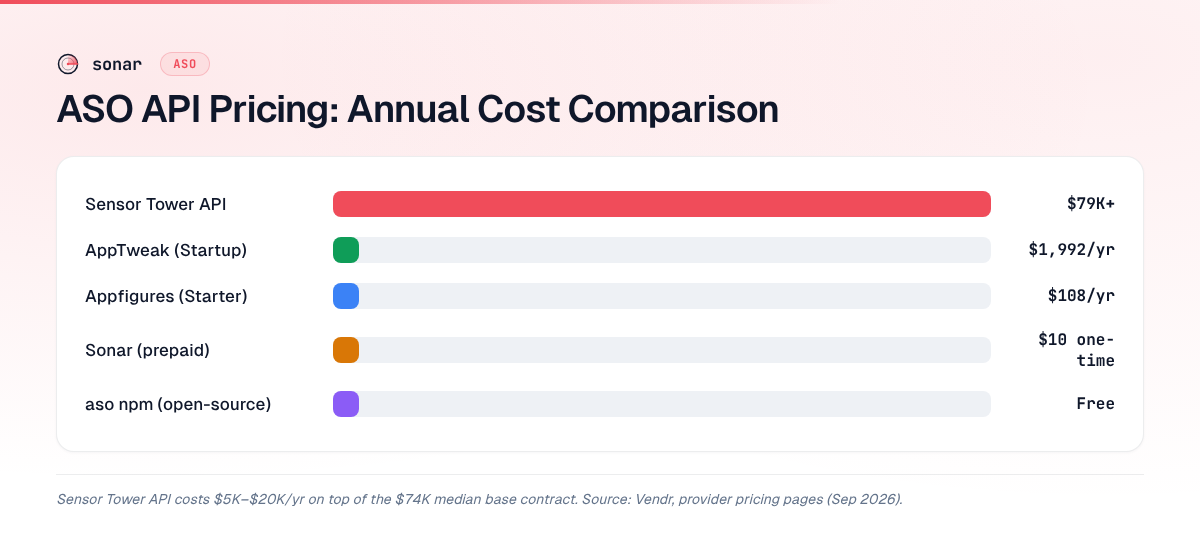
The pricing gap is not subtle. An indie developer spending $10 on Sonar prepaid credits gets the same data shape — keyword difficulty, popularity scores, download estimates — that a Sensor Tower API customer pays thousands to access. The difference is scope: Sensor Tower bundles ad intelligence, audience demographics, and revenue estimates across 60+ countries. If you need those enterprise modules, the price makes sense. If you need keyword data for ASO, it does not.
What Data the Sensor Tower API Returns (and What It Lacks)
Based on integration reports from teams that have used the Sensor Tower API, the endpoint categories include:
- Store Intelligence — download and revenue estimates by app, category, country, and date range.
- App Intelligence — keyword rankings, metadata snapshots, ratings and reviews.
- Ad Intelligence — creative assets, ad spend estimates, network breakdowns.
- Audience Intelligence — demographic and behavioral data (requires panel integration).
- Usage Intelligence — DAU/MAU estimates, session data, retention curves.
The strength of this API is breadth. No other single provider covers all five categories in one contract. The weakness is that download and revenue estimates are model-derived and can miss significantly — one developer publicly reported Sensor Tower listing their app at $40K MRR when the actual figure was $90K, a 2.25x underestimate (source: @SinaSinry on X, 2025).
For keyword-level ASO data specifically — difficulty scores, popularity, competitor counts — the Sensor Tower API returns similar fields to what smaller providers offer. The difference is that Sensor Tower calculates these from its own panel data, while providers like Sonar source popularity directly from Apple's Search Ads API where available.
The Post-Merger Documentation Problem
Before the acquisition, Data.ai (formerly App Annie) maintained public API documentation with endpoint references, example responses, and rate-limit tables. Developers could browse schemas, test sandbox calls, and scope integration work before signing a contract. After Sensor Tower absorbed Data.ai in March 2024 (source: TechCrunch), that documentation was retired. As of October 2026 the unified Sensor Tower API reference sits at app.sensortower.com/api/docs behind the customer sign-in, so it still is not a public technical reference.
This creates a real problem for engineering teams: you cannot scope an integration without signing a contract first. In practice, an engineering team cannot see endpoint schemas or test response payloads until the account — and therefore the contract — is in place, so integration effort can only be estimated after procurement.
When I built Sonar's API, I made the opposite choice — full endpoint docs at trysonar.app/docs/api, a keyless tier for testing, and prepaid credits so no one locks into an annual commitment to evaluate the data. Sonar's /api/v1/keywords/search, /api/v1/keywords/suggestions, and /api/v1/apps/search endpoints are all documented with example requests and responses.
The sensor tower api documentation gap is not a dealbreaker for enterprise buyers with dedicated sales engineers who handle onboarding, but it is a hard blocker for indie developers and small studios doing build-vs-buy evaluations on a two-week sprint cycle.
What Indie Developers Actually Need from an ASO API
Most indie developers querying an ASO API need three things: keyword difficulty, keyword popularity (or search volume proxies), and competitive landscape data. They do not need ad spend tracking, audience demographics, or usage intelligence — those are enterprise analytics features.
Here is a concrete example. Sonar's keyword endpoint returns "budget planner" at iOS difficulty 64 with Apple-reported popularity 50 and 191 competing results, plus an estimated 390 daily downloads at rank #1 (source: Sonar /api/v1/keywords/search, queried 2026-09-01). That single API call gives an indie developer everything they need to decide whether "budget planner" is worth targeting.
Querying "habit tracker" via Sonar shows iOS difficulty 64 with Apple-reported popularity 58 and an estimated 630 daily downloads at rank #1 — a more competitive surface than "budget planner" (source: Sonar /api/v1/keywords/search, queried 2026-09-01). In my testing, both queries returned in under 500ms, cost a fraction of a cent on the prepaid tier, and required no sales call.
Cross-platform comparison: "budget planner" scores iOS difficulty 64 (popularity 50) vs Android difficulty 63 (popularity 42, proxy-estimated) — showing similar competitive intensity across stores (source: Sonar /api/v1/keywords/search, queried 2026-09-01). This kind of cross-store keyword analysis is exactly the use case where an API matters — it feeds automated pipelines, CI/CD checks, and ASO MCP agents that adjust metadata based on live difficulty data.
Try Sonar's ASO API with a request without an API key, then use prepaid credits when you need higher limits.
For a full comparison of how Sonar stacks up against AppTweak, Appfigures, and other ASO APIs, see our ASO APIs compared breakdown.
The Open-Source Option: the aso npm Library
The aso npm package is a free, open-source library that scrapes public App Store and Play Store data. It returns autocomplete suggestions, app rankings for a keyword, and review text. It does not return popularity scores or computed difficulty ratings because those require proprietary data pipelines — Apple's Search Ads API for iOS popularity, and statistical models for difficulty.
If you only need raw rankings and suggestions, aso npm costs nothing. If you need the metrics that drive actual ASO decisions — difficulty and popularity scores — you need a provider that computes them. Sensor Tower, Sonar, AppTweak, and Appfigures all do. The question is price and how much you want to automate. For developers building Claude-powered ASO workflows, a documented API with a free tier is the practical starting point — you can wire it into an agent and iterate before spending anything.
Choosing Between Sensor Tower API and Indie Alternatives
The decision framework is straightforward:
- Choose Sensor Tower if your team needs ad intelligence, audience demographics, or revenue estimates alongside keyword data — and your budget supports $79K+/year for platform plus API access. Enterprise mobile gaming studios and performance marketing agencies are the core use case.
- Choose Sonar if you need keyword difficulty, popularity, download estimates, and app search via a documented, pay-as-you-go API. Entry cost: $0 (keyless) or $10 (prepaid). Full docs at trysonar.app/docs/api.
- Choose AppTweak if you need a premium ASO platform with API access, competitive intelligence, and ad data at a mid-market price point (~$166/month entry). Source: AppTweak pricing page (apptweak.com/en/pricing), accessed 2026-09-01.
- Choose Appfigures if you want analytics and ASO in one dashboard with API access starting at ~$9/month. Source: Appfigures pricing page (appfigures.com/pricing), accessed 2026-09-01.
For a broader comparison including tools without API access, see our Sensor Tower alternatives roundup.
FAQ
Does Sensor Tower have a public API?
Sensor Tower offers an API, but its documentation at app.sensortower.com/api/docs requires a customer login. Endpoint details, schemas, and rate limits are visible only once you have an account, which in practice means after signing a contract. The API is an add-on to the base platform subscription, priced at $5,000-$20,000/year according to Vendr marketplace data.
Does Sensor Tower have an MCP server?
Yes. Sensor Tower announced an official MCP server in July 2026 that exposes App Advertising and App Performance data to Claude, ChatGPT, or a custom LLM. It is sold as "an additional product for qualifying Sensor Tower users," so you need an existing subscription (source: Sensor Tower blog). A community-built alternative, sensortower-mcp, also exists but still needs your own Sensor Tower API token (source: GitHub). If you want an ASO MCP server you can try without a contract, Sonar's runs keyless on a free tier — compared in our ASO MCP servers roundup.
How much does the Sensor Tower API cost?
The Sensor Tower API costs $5,000-$20,000/year as a separate add-on to the base subscription (source: Vendr). Since the median base contract is $74,415/year across 38 anonymized transactions, total cost with API access is typically $79,000-$94,000/year.
What happened to Data.ai's API after the Sensor Tower acquisition?
Sensor Tower acquired Data.ai in March 2024 (source: TechCrunch). Data.ai's previously public API documentation was retired. The combined API's docs now sit behind Sensor Tower's customer login at app.sensortower.com/api/docs, with access sold through the enterprise sales process.
What is the cheapest ASO API with keyword difficulty data?
Sonar offers a free keyless API tier that returns keyword difficulty, Apple-reported popularity scores, and download estimates. Paid access starts at $10 prepaid with no annual contract. Full documentation is available at trysonar.app/docs/api. Appfigures is another budget option starting at ~$9/month.
Can I use the aso npm library instead of Sensor Tower's API?
The aso npm library is free and open-source, but it only scrapes public data — autocomplete suggestions, rankings, and reviews. It does not provide popularity scores, difficulty ratings, or download estimates. If you need those metrics for ASO decisions, you need a paid provider like Sonar, AppTweak, or Appfigures.
Need ASO keyword data without the enterprise price tag? Try Sonar free — it returns difficulty, popularity, and download estimates for every keyword, with full API docs and no sales call required.