 sonar
sonar
What Is a Mobile Measurement Partner, and Why Does It Matter?
A mobile measurement partner (MMP) is a third-party service that tracks which ad clicks, campaigns, and channels drive app installs and post-install events. The major players — AppsFlyer, Adjust, Branch, Singular, and Kochava — sit between ad networks and app developers, providing a single source of truth for attribution data. According to AppsFlyer's documentation, an MMP resolves the fundamental problem of matching a user who clicked an ad on one platform to the same user who later opened an app on their device.
But the attribution landscape shifted hard after Apple introduced App Tracking Transparency (ATT) in iOS 14.5 in April 2021 (source: Apple Developer, WWDC21). ATT forced every iOS app to ask explicit permission before tracking users across apps and websites. Opt-in rates have hovered between 25% and 35% globally since launch, according to Adjust's Mobile App Trends 2024 report. That single change made deterministic, device-level attribution — the core value proposition of every MMP — far less reliable on iOS.
The question in 2026 is no longer "which MMP should I use?" but "do I need one at all?" When I started advising indie developers on attribution setups through Sonar, I noticed most of them were paying for MMP features they never used. The answer depends on your ad spend, your platform mix, and whether Apple's own first-party attribution tools cover your needs. Understanding what App Tracking Transparency did to conversion measurement is the first step to answering that honestly.
How Mobile Attribution Worked Before ATT
Before ATT, mobile measurement partners relied on Apple's Identifier for Advertisers (IDFA) and Google's Google Advertising ID (GAID) to perform deterministic attribution. The process was straightforward: a user clicked an ad, the MMP recorded the device ID, and when the app was installed and opened, the MMP matched the install to the click using the same device ID. Match rates routinely exceeded 90% (source: AppsFlyer Performance Index, Edition XIII, 2021).
This model made MMPs indispensable. Without them, you had no way to know whether a $50,000 Facebook campaign actually drove installs or whether those users would have found your app organically anyway.
Google Play still supports GAID-based attribution in 2026, though Google has announced its Privacy Sandbox for Android initiative, which will eventually replace GAID with privacy-preserving APIs like the Attribution Reporting API. The timeline remains unclear — Google has delayed the full deprecation of GAID multiple times since announcing it in February 2022 (source: Android Developers Blog).
SKAdNetwork and AdAttributionKit: What Apple Gives You for Free
Apple's SKAdNetwork (SKAN) is a privacy-preserving attribution framework built into iOS. It provides campaign-level attribution — telling you which ad network and campaign drove an install — without revealing any user-level data. SKAN 4.0, released with iOS 16.1, introduced three postback windows (0–2 days, 3–7 days, 8–35 days) and hierarchical conversion values with up to 4,096 fine-grained conversion combinations (source: Apple Developer Documentation, SKAdNetwork).
At WWDC 2024, Apple introduced AdAttributionKit as the successor to SKAdNetwork, extending the same privacy-preserving framework to additional ad contexts including re-engagement campaigns (source: Apple Developer, WWDC24 session 10070). AdAttributionKit retains SKAN 4.0's postback structure while adding developer-mode testing and support for custom ad networks.
Here is what Apple's free tools can and cannot do:
| Capability | SKAN 4.0 / AdAttributionKit | Third-Party MMP |
|---|---|---|
| Campaign-level install attribution | Yes | Yes |
| Ad network identification | Yes | Yes |
| User-level tracking (with consent) | No | Yes (ATT opt-in only) |
| Multi-touch attribution | No | Yes |
| Deep-link attribution | No | Yes |
| Real-time postbacks | No (24–48 hr delay) | Near real-time |
| Cross-platform (iOS + Android) | No | Yes |
| Re-engagement attribution | Limited (AdAttributionKit) | Yes |
| Cost per install aggregation | No | Yes |
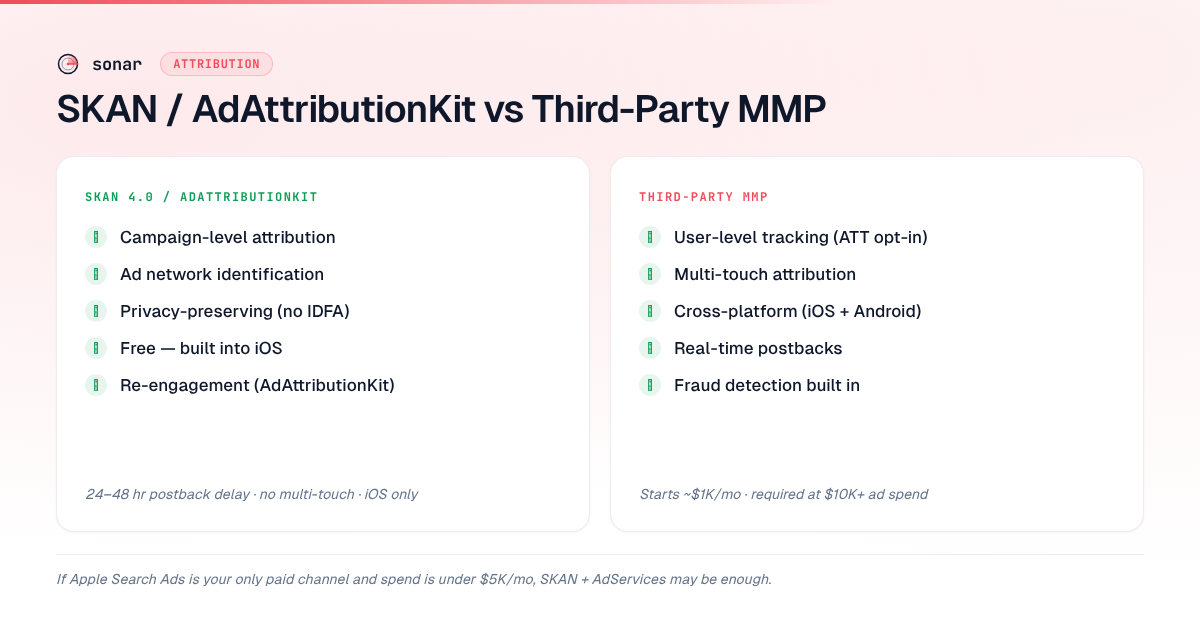
For developers running Apple Search Ads specifically, Apple provides its own deterministic attribution API. If Apple Search Ads is your primary paid channel, this API plus SKAN may cover all the attribution you need. We analyzed how this works in depth in our guide to Apple Search Ads attribution with AppsFlyer, which also covers the edge cases where Apple's own data falls short.
The Indie Threshold: When an MMP Pays for Itself
An MMP subscription is not cheap. AppsFlyer's Zero plan covers up to 10,000 conversions per month for free, but full attribution features start at roughly $0.05–$0.12 per conversion on paid tiers (source: AppsFlyer pricing page, accessed August 2026). Adjust's pricing is custom and typically starts at $1,000/month for smaller apps (source: Adjust sales documentation, 2025). Singular and Branch offer similar tiered structures.
The indie developer math is simple: if you're spending less than $3,000/month on paid acquisition across all channels, the cost of an MMP likely exceeds the value of the attribution data it provides. Here is why.
At $3,000/month in ad spend, assuming a blended CPI of $2.50 (the median CPI across all verticals in the US for 2025, per Liftoff's Mobile Ad Creative Index 2025), you're generating approximately 1,200 installs from paid channels. The attribution question at this scale is: "Did my $3,000 work better on Facebook or Google?" You can answer that question with SKAN postbacks, Apple Search Ads attribution, and Google's own install reporting — without paying for an MMP.
The threshold shifts when any of these conditions apply:
- You spend over $10,000/month on paid UA — at this scale, a 5% improvement in channel allocation from better attribution easily saves more than the MMP cost.
- You run campaigns on 3+ ad networks simultaneously — SKAN postbacks arrive from each network independently, with no deduplication. An MMP deduplicates and normalizes across networks.
- You need post-install event attribution — understanding which campaigns drive paying users, not just installs, requires the conversion value mapping that MMPs handle far more flexibly than raw SKAN.
- You operate cross-platform (iOS + Android) — SKAN only covers iOS. If you need unified attribution across both stores, you need an MMP or a custom build.
Understanding your full user acquisition cost structure is essential before committing to MMP spend. If you do not know your blended CPI, you cannot calculate whether better attribution will actually move your ROI.
Why Cross-Platform Attribution Cannot Be Ignored
Sonar's keyword index shows "tip calculator" at iOS difficulty 38 versus Android difficulty 17 — a gap wide enough that the same paid campaign will face entirely different competitive pressure on each platform. Across the 50+ indie apps I've tracked in Sonar, this kind of cross-platform divergence is the norm, not the exception, and it makes platform-specific attribution non-negotiable.
The divergence runs even deeper for niche categories. For "subscription tracker," Sonar reports iOS difficulty 43 with 199 competing apps versus Android difficulty 23 with only 27 results — confirming that the competitive environment a user enters differs so sharply between stores that attributing installs by platform is table stakes, not a luxury.
What does this mean for attribution? A paid campaign targeting "subscription tracker" on iOS faces nearly 7.4 times more competing apps (199 vs. 27) than the same campaign on Android. If your MMP — or your manual attribution setup — treats "installs from the subscription tracker campaign" as a single bucket, you are masking a massive difference in competitive cost and organic uplift between platforms. Effective mobile measurement partners segment attribution by store, keyword, and campaign at a minimum.
MMP Comparison: The 5 Major Players in 2026
Choosing a mobile measurement partner requires matching your scale, platform mix, and feature needs to the right vendor. When I evaluated these five MMPs for apps using Sonar, the deciding factors were almost always fraud detection depth and how many ad network integrations the platform supports out of the box. Here is how the five major MMPs compare on the dimensions that matter most:
| MMP | Free Tier | Ad Network Integrations | Postback Support | Cross-Platform | Fraud Detection | Best For |
|---|---|---|---|---|---|---|
| AppsFlyer | Up to 10K conversions/mo | 10,000+ | SKAN 4.0 + AdAttributionKit | iOS + Android + Web | Protect360 (paid add-on) | Mid-to-large apps with multi-network spend |
| Adjust | No free tier | 2,000+ | SKAN 4.0 + AdAttributionKit | iOS + Android + CTV | Built-in | Subscription apps, gaming studios |
| Branch | Free for deep linking | 1,500+ | SKAN 4.0 | iOS + Android + Web | Limited | Apps where deep linking is critical |
| Singular | Free tier available | 3,000+ | SKAN 4.0 + AdAttributionKit | iOS + Android | Built-in | Cost aggregation across ad networks |
| Kochava | Free tier (Marketers Operating System) | 4,500+ | SKAN 4.0 | iOS + Android + CTV | Built-in | Enterprise apps with CTV campaigns |
Sources: AppsFlyer product page, Adjust product page, Branch documentation, Singular product page, Kochava product page.
All five support SKAN 4.0 postback ingestion. The real differentiators in 2026 are fraud detection quality, cost aggregation (pulling spend data directly from ad networks via API), and the flexibility of conversion value mapping for SKAN's limited 6-bit or hierarchical models.
When Apple's Own Data Is Enough
For a significant segment of developers, Apple's first-party tools provide sufficient attribution without an MMP. This segment includes developers who meet all of the following criteria:
- iOS-only app — no Android version to unify.
- Apple Search Ads is the only paid channel — Apple provides deterministic, keyword-level attribution for its own ads via the AdServices framework (source: Apple Developer Documentation, AdServices).
- Spend under $5,000/month — the value of multi-touch attribution and fraud detection at this scale rarely justifies MMP cost.
- Organic is the primary growth channel — if most installs come from App Store search, browse, or referrals, SKAN postbacks cover the small paid slice.
Apple Search Ads' own attribution tells you the exact keyword, ad group, and campaign that drove each install. It even reports conversion rates by keyword. For an indie developer running $2,000/month in Apple Search Ads and relying heavily on organic ASO as the primary acquisition strategy, this data combined with App Store Connect analytics is genuinely enough.
The break point comes when you add a second paid channel. The moment you run Google Ads, Meta Ads, or TikTok alongside Apple Search Ads, you lose the ability to deduplicate installs across networks without an MMP or a custom solution. A user might click a Meta ad and then later click an Apple Search Ad before installing — who gets credit? Without an MMP, both networks claim the install, and your blended CPI looks artificially low.
Building a Lightweight Attribution Stack Without an MMP
If you've determined that an MMP is overkill for your current scale, you can build a functional attribution stack using free or low-cost tools. I've helped several indie developers set up exactly this stack, and it covers the basics well until ad spend crosses the $5,000–$10,000/month range:
- Apple Search Ads Attribution API (AdServices) — provides deterministic attribution for Apple Search Ads installs, including keyword and campaign data. Requires integrating the AdServices framework into your app (source: Apple Developer Documentation).
- SKAdNetwork / AdAttributionKit postbacks — provides campaign-level attribution for all other iOS ad networks. Configure conversion value schemas using Apple's documentation or a free tool like SKAN.is.
- Google Play Install Referrer API — provides deterministic attribution for Android installs from Google Ads and other supported networks (source: Google Developer Documentation).
- App Store Connect + Google Play Console analytics — both provide organic vs. paid install splits, source breakdowns, and conversion funnels at no cost.
- Firebase / Google Analytics for Firebase — free event tracking and basic campaign attribution for both platforms (source: Firebase documentation).
This stack covers single-channel paid attribution on both platforms, organic attribution, and basic post-install event tracking. It breaks down when you need multi-network deduplication, fraud detection, or unified cross-platform reporting — which is exactly where a mobile measurement partner earns its cost.
FAQ
What does a mobile measurement partner actually do?
A mobile measurement partner (MMP) tracks which ad clicks, campaigns, and channels drive app installs and in-app events. It sits between ad networks and your app, deduplicating install claims and providing a single attribution source of truth. The five major MMPs in 2026 are AppsFlyer, Adjust, Branch, Singular, and Kochava (source: AppsFlyer, Adjust, Branch, Singular, Kochava product pages).
Is SKAdNetwork a replacement for an MMP?
SKAdNetwork (and its successor AdAttributionKit) provides campaign-level attribution for iOS without user-level tracking, but it lacks multi-touch attribution, real-time postbacks, fraud detection, and cross-platform support. For developers running a single paid channel under $5,000/month, SKAN may be sufficient. For multi-network campaigns above that threshold, an MMP fills critical gaps that SKAN cannot address (source: Apple Developer Documentation, SKAdNetwork).
How much does an MMP cost?
MMP pricing varies widely. AppsFlyer offers a free tier covering up to 10,000 conversions per month, with paid plans charging roughly $0.05–$0.12 per conversion. Adjust typically starts at $1,000/month for smaller apps. Branch is free for deep-linking use cases. The general rule: if your monthly paid UA spend is under $3,000, the MMP cost likely exceeds the value of the incremental attribution data (source: AppsFlyer and Adjust pricing pages, accessed August 2026).
Do Android apps need an MMP?
Android still supports Google Advertising ID (GAID) for deterministic attribution, making device-level tracking more straightforward than on iOS post-ATT. However, Google's Privacy Sandbox for Android will eventually replace GAID with privacy-preserving APIs (source: Android Developers Blog, 2022). Android developers running campaigns on multiple ad networks benefit from an MMP's deduplication and fraud detection even before the Privacy Sandbox transition.
Can I switch from one MMP to another?
Yes, but migration is nontrivial. Historical attribution data typically does not transfer between MMPs, so you lose continuity in your cohort analyses. The technical integration — SDK swap, postback reconfiguration, conversion value remapping — generally takes several weeks depending on your app's complexity and the number of ad network integrations you need to re-establish. Plan the switch during a low-spend period to minimize data gaps.
Want to understand how cross-platform keyword competition affects your install attribution? Try Sonar free — it shows search volume, difficulty, and competitor counts for every keyword across both the App Store and Google Play.