sonar
sonar
Generative Engine Optimization Tools: What Each Category Does and When You Need It
A peer-reviewed study from Princeton, Georgia Tech, IIT Delhi, and AI2 — presented at KDD 2024 — tested nine content optimization methods across 10,000 queries and found that adding inline citations improves AI citation visibility by 30–40%, while adding statistics improves it by 41%. Keyword stuffing, the method most borrowed from traditional SEO, produced near-zero or negative results. That gap between what works and what people assume works is exactly where GEO tools come in.
This post covers the GEO tool landscape broadly — monitoring platforms, content optimization tools, and hybrids that do both. If you're specifically looking for tools that track AI brand mentions (Profound, Peec AI, Otterly), we covered those in depth in our best AI visibility tools roundup. If you're an app developer looking at where GEO meets ASO, the answer engine optimization tools for apps post covers that angle. This article sits between the two: the full GEO tool stack for anyone creating content that needs to be cited by AI engines.
What GEO Is — and What It Is Not
Generative engine optimization is the practice of modifying content so that AI engines (ChatGPT, Perplexity, Claude, Google AI Mode, Gemini) cite it when assembling answers. The term was coined in the Princeton GEO paper (KDD 2024), which introduced both the concept and the GEO-bench benchmark for measuring it.
GEO is not traditional SEO. SEO optimizes for position in a ranked list of links. GEO optimizes for citation in a synthesized answer — a fundamentally different output format where there are no "positions," only passages that survive extraction or get discarded. Per OpenAI/SearchGPT analyses, only about 15% of retrieved pages end up as visible citations (Seer Interactive, 2026). The other 85% are read by the model and dropped.
GEO is also distinct from AEO (Answer Engine Optimization), though the terms overlap in practice. AEO is the industry term that emphasizes the "answer engine" framing. GEO is the academic term from the Princeton paper. Both describe the same goal: making content citable by AI. Throughout this article, I use GEO because the tools in this category increasingly self-label that way.
The Two Sides of GEO: Monitoring vs Optimizing
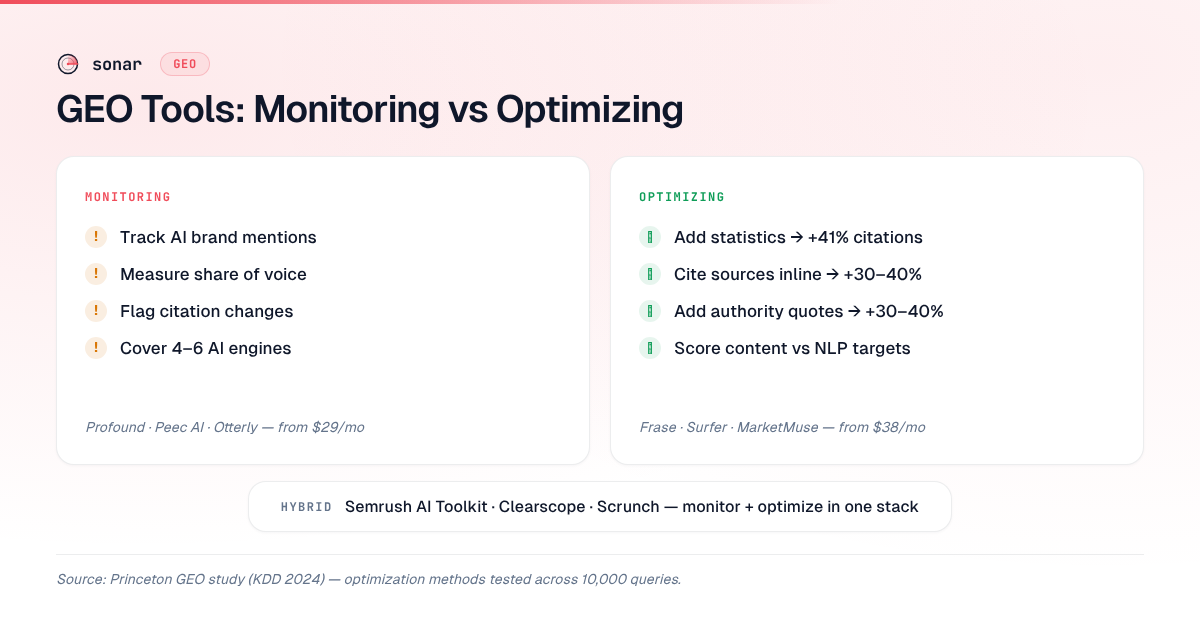
GEO tools split into two functional categories, and confusing them leads to wasted spend.
Monitoring tools track where AI engines currently cite your brand. They answer the question: "Does ChatGPT mention us when someone asks about our category?" Platforms like Profound, Peec AI, and Otterly sit here. They scan AI outputs across multiple engines, measure share of voice, track sentiment, and flag when competitors gain or lose citations. They tell you what is happening — not how to fix it.
Optimization tools change your content to make it more citable. They answer a different question: "What should I write, and how should I structure it, so AI engines quote my page?" Tools like Frase, Surfer SEO, MarketMuse, and Clearscope sit here. They analyze top-performing content, score your drafts against semantic targets, and increasingly include AI-specific optimization features like entity density scoring and citation-likelihood prediction.
A third category — hybrid platforms — is emerging. Scrunch, Semrush's AI Toolkit, and Clearscope now offer both monitoring and optimization in a single product, though each leans heavier toward one side.
The distinction matters because a monitoring tool cannot improve your content, and an optimization tool cannot tell you whether AI engines currently mention your brand. Most teams need both, but buying them in the wrong order wastes budget. If AI engines already cite you frequently, start with monitoring to protect that position. If they don't cite you at all, start with optimization to create citable content first.
GEO Tools Compared: Monitoring, Optimization, and Hybrid
The table below maps the major GEO tools by primary function, starting price, and which AI engines they cover.
| Tool | Category | Starting Price | AI Engines Covered | Best For |
|---|---|---|---|---|
| Profound | Monitoring | $99/mo | ChatGPT, Perplexity, Gemini, Claude, AI Overviews | Enterprise teams tracking 50+ brand queries across 5 engines |
| Peec AI | Monitoring | $89/mo | ChatGPT, Perplexity, Gemini, Copilot, AI Mode, AI Overviews | SEO teams needing 6-engine coverage at mid-tier pricing |
| Otterly | Monitoring | $29/mo | ChatGPT, Perplexity, Copilot, AI Overviews (others as add-ons) | Solo operators or startups under $50/mo budget |
| HubSpot AEO Grader | Monitoring (free) | Free | ChatGPT, Perplexity, Gemini | One-time baseline score before committing to paid tools |
| Frase | Optimization | $38/mo | N/A (content scoring, not tracking) | Solo creators needing research-to-draft in one workflow |
| Surfer SEO | Optimization | $99/mo | ChatGPT (Standard); multi-platform on Pro ($182/mo) | Content teams scoring 20+ articles/mo against NLP targets |
| MarketMuse | Optimization | $149/mo | N/A (content strategy, not tracking) | Content strategists mapping topic clusters across 100+ pages |
| Clearscope | Hybrid | $129/mo | ChatGPT, Gemini | Teams wanting content grading + AI citation tracking in one UI |
| Semrush AI Toolkit | Hybrid | $99/mo add-on | ChatGPT, Gemini, Perplexity, AI Mode, AI Overviews | Existing Semrush users adding AI visibility to their stack |
| Scrunch | Hybrid | $250/mo | Multi-engine (varies) | Organizations needing monitoring + auditing + AI content delivery |
Sources: Pricing verified via vendor websites and Am I Cited pricing breakdown (2026), SitePoint GEO tool review (2026), and Cakewalk AI comparison.
Content Optimization Tools: What Actually Improves AI Citability
The Princeton GEO study remains the only peer-reviewed benchmark for which optimization methods work. Their findings, tested across the GEO-bench framework of 10,000 queries, ranked methods by visibility lift:
| Optimization Method | Visibility Lift | Example |
|---|---|---|
| Add statistics | +41% | Replace "many users" with "12,400 monthly users" |
| Cite sources inline | +30–40% | Add "[source: Apple Developer Docs]" after a claim |
| Add authority quotations | +30–40% | Include a named expert's direct quote |
| Authoritative tone | Moderate | Confident, specific language over hedging |
| Keyword stuffing | Near zero / negative | Repeating target phrases unnaturally |
Source: Aggarwal et al., GEO: Generative Engine Optimization, KDD 2024.
The study also found that position-5 pages gained +115% visibility from these techniques, while position-1 pages gained almost nothing. This means GEO disproportionately benefits content that isn't already dominant — the exact situation a new blog post or product page is in.
Content optimization tools operationalize these findings in different ways:
- Frase ($38/mo) generates content briefs from SERP analysis and now includes AI Search Tracking that monitors where your brand appears in AI answers. Its research-to-draft workflow is the fastest in this category for solo creators. Source: Frase blog, 2026.
- Surfer SEO ($99/mo Standard) scores content against NLP entity targets and, as of 2026, evaluates entity density and structured Q&A formats to maximize citation frequency in AI Overviews. The Pro plan ($182/mo) adds multi-platform AI visibility tracking across Perplexity, Google AI Mode, and Gemini. Source: AI Tools DevPro, Surfer SEO Guide 2026.
- MarketMuse ($149/mo) maps topic clusters and identifies content gaps across an entire site. It does not track AI citations directly but its topic authority scoring aligns with what the Princeton study found effective — comprehensive, expert-level coverage of a subject. Source: Cakewalk AI comparison, 2026.
- Clearscope ($129/mo Essentials, $399/mo Business) has evolved from pure content grading into what it calls a "discoverability platform." It tracks brand presence in ChatGPT and Gemini responses and shows which web searches AI models make when compiling answers. It does not yet cover Perplexity, Google AI Mode, or AI Overviews. Source: Clearscope review, TheStacc 2026.
Hybrid Platforms: Monitoring and Optimization in One Stack
Three platforms are converging monitoring and optimization into single products.
Semrush AI Toolkit ($99/mo add-on to any Semrush base plan) indexes 126 million AI search prompts — the largest published prompt dataset in the category. It covers ChatGPT, Gemini, Perplexity, Google AI Mode, and AI Overviews. On the optimization side, Semrush's existing content tools (SEO Writing Assistant, Topic Research) still function for traditional content scoring, though they weren't designed with AI citation in mind.
Scrunch ($250/mo billed annually, acquired by Sitecore in June 2026) offers four integrated modules: monitoring, auditing, optimization, and an "Agent Experience Platform" (AXP) for content delivery to AI crawlers. It's the most explicitly GEO-native platform in this list — built from scratch for AI visibility rather than adapted from an SEO tool.
HubSpot AEO provides a free one-time grader that scores your brand across five dimensions — Sentiment (40 pts), Presence Quality (20 pts), Brand Recognition (20 pts), Share of Voice (10 pts), and a market-score component — without requiring a signup. The paid monitoring tier tracks ongoing mentions across ChatGPT, Gemini, and Perplexity. HubSpot reports (without publishing methodology) that beta customers saw AI-referred traffic increase roughly 20%. Source: HubSpot AEO page.
Where GEO Meets ASO: The App Developer Angle
App developers face a specific GEO challenge: a 2026 analysis of 366,000 AI citations across ChatGPT, Perplexity, and Google found that AI engines pull from diverse source types — not just traditional web pages — which means store listings, review corpora, and web content are all fair game for extraction. This creates an optimization surface that standard GEO tools don't cover. Store metadata — the 30-character iOS title, the 4,000-character Play Store description — functions as source text that AI models extract from, but no pure GEO tool audits App Store or Play Store listings for AI extractability.
When I evaluated the tools in this roundup against app-specific workflows, the gap became clear: every platform assumes web content as input. None ingests an App Store product page or Play Store listing directly. The bridge is partly filled by ASO platforms that feed structured data to AI agents. Sonar's MCP integration, for example, connects keyword and competitive data directly to Claude and ChatGPT through the Model Context Protocol, making app positioning data available to the AI systems doing the recommending.
For a detailed breakdown of how AI assistants source app recommendations and what app developers can control, see the dedicated AEO tools for apps post. The short version: if you're optimizing an app's AI visibility, you need both a GEO-aware content strategy for your web presence and ASO infrastructure for your store listings. No single tool covers both today.
How to Evaluate Which GEO Tool Category You Need
Choosing the right GEO tools depends on where you are in the AI visibility lifecycle. Three questions clarify the decision.
1. Do AI engines currently cite you? Run HubSpot's free AEO Grader or manually query ChatGPT and Perplexity for your core topics. If you already appear in answers, a monitoring tool (Peec AI, Profound, Otterly) helps you protect and track that position. If you don't appear at all, monitoring an absence is pointless — start with optimization.
2. Do you already pay for an SEO platform? If you're on Semrush, the $99/mo AI Toolkit add-on is the lowest-friction path to GEO monitoring. If you use Surfer SEO, the Pro plan ($182/mo) adds multi-platform AI tracking. Building on existing tools avoids duplicate costs and workflow fragmentation.
3. Is your priority web content or app listings? Every GEO tool in this roundup is built for web content. If your primary concern is whether ChatGPT recommends your mobile app, the GEO tool stack needs to be supplemented with ASO data. In building Sonar's keyword index, I found that the metadata fields AI models actually extract from — titles, subtitles, short descriptions — are exactly the fields ASO tools optimize. Check the best AI ASO tools for 2026 for that layer.
For most teams, the practical starting stack is a content optimization tool (Frase or Surfer at $38–$99/mo) paired with a monitoring tool (Otterly at $29/mo or HubSpot's free grader). Scale to a hybrid platform like Semrush or Scrunch once you have enough AI visibility to justify the spend.
FAQ
What are generative engine optimization tools?
Generative engine optimization tools are platforms that help content appear as citations in AI-generated answers from ChatGPT, Perplexity, Claude, Google AI Mode, and similar engines. They split into two categories: monitoring tools that track where AI engines mention your brand, and optimization tools that modify content structure to increase citation likelihood. The term was coined in a Princeton study (KDD 2024) that tested optimization methods across 10,000 queries.
What is the difference between GEO monitoring and GEO optimization tools?
Monitoring tools (Profound, Peec AI, Otterly) track whether AI engines currently cite your brand, measuring share of voice, sentiment, and citation sources across multiple platforms. Optimization tools (Frase, Surfer SEO, MarketMuse) improve your content's structure and sourcing to make it more citable. Monitoring tells you what is happening; optimization changes what will happen. Most teams eventually need both, but the right starting point depends on whether AI engines already cite you.
Which GEO optimization methods actually work?
The Princeton GEO study (KDD 2024) found that adding statistics to content improves AI citation visibility by 41%, citing sources inline improves it by 30–40%, and adding authority quotations improves it by 30–40%. Keyword stuffing — the most common SEO tactic — produced near-zero or negative results. These findings were tested across the GEO-bench benchmark of 10,000 queries.
How much do GEO tools cost in 2026?
Prices range from free (HubSpot's AEO Grader for a one-time snapshot) to $250+/mo (Scrunch's hybrid platform). The most common price points are $29–$99/mo for monitoring (Otterly, Peec AI, Profound starter) and $38–$182/mo for content optimization (Frase, Surfer SEO, MarketMuse). Semrush's AI Toolkit costs $99/mo as an add-on to a base subscription. Clearscope starts at $129/mo for a hybrid monitoring-and-optimization approach.
Do I need a GEO tool if my content already ranks well on Google?
Ranking well on Google is necessary but not sufficient for AI citation. Ahrefs research across 863,000 SERPs found that only 38% of AI Overview citations come from top-10 organic results — down from 76% in July 2025. Your page can rank #1 on Google and still be absent from ChatGPT and Perplexity answers if the content isn't structured for extraction. A GEO optimization tool helps close that gap by making your existing high-ranking content more citable.
Can GEO tools optimize content for all AI engines at once?
No single tool covers every engine equally. Semrush's AI Toolkit tracks five engines (ChatGPT, Gemini, Perplexity, AI Mode, AI Overviews), the widest coverage in this roundup. Clearscope covers only ChatGPT and Gemini. On the optimization side, the Princeton study's methods — adding statistics, inline citations, and authoritative quotes — improve citability across all engines because every major AI model uses a similar retrieval-rerank-synthesis pipeline (Aggarwal et al., KDD 2024). The content techniques are engine-agnostic even if the monitoring tools are not.
---
Want to see how your app's keywords perform across iOS and Android stores — with data structured for AI agent workflows? Try Sonar free — it shows search popularity, difficulty, and competitor data for every keyword.